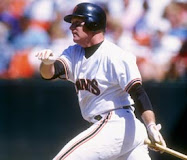
Showing posts with label Madison Bumgarner. Show all posts

Friday, May 3, 2019

Appreciating the Final Days of Bumgarner as a Giant

Giants Ace Madison Bumgarner is still a Giant. Yes, there are rumors swirling more than ever, especially as the Giants sit in last place in the NL West at 13–18 as of May 1st, and sport the worst offense in all of baseball, according to wRC+. But as of now, Bumgarner is still the Giants’ best pitcher in the rotation, and arguably the best and biggest superstar on the Giants roster as of this moment (the only other competition may be battery mate Buster Posey). MadBum will bring Giants fans to the stadium, and not only will he perform, but he will also ignite memories of a Giants past that was a lot more successful and memorable.


Last night fit that bill perfectly, as Bumgarner went six innings, and struck out eight Dodger hitters, while only allowing four hits, two walks, and a run on 114 pitches. It was classic Bumgarner, what Giants fans have been used to for about a decade: not exactly the prettiest, not perfect, but still solid when it mattered most. And as usual, Bumgarner did it on the big stage, against Giants fans’ most hated opponent at Oracle Park.


Bumgarner didn’t get the win (per usual this year, the offense couldn’t back up the Giants’ stellar pitching), but it was a nice showcase for the 29-year-old ace, who showed that despite injury issues the past couple of years, he can still bring it and compete at the highest level. And while that is nice for Giants fans who may still hold onto the glimmer of hope that the organization can still stay in the playoff race (after all…we’ve only been a month into the season), it is more relevant to other organizations in baseball: Bumgarner is available, he is in the last year of his deal, and he can still perform against the best teams in baseball.

As he walked off the mound after finishing the sixth inning, you could sense that this performance may be the beginning of the end for MadBum in the black and orange. With pitching a premium around the league, and more crucial than ever for playoff qualification as well as success, there are not many pitchers on the market who are as affordable and reputable as Bumgarner. And for the Giants, with a terrible offense, an aging roster, and a thin farm system, getting some kind of return to booster this organization from the bottom up is more important than ever for new head honcho Farhan Zaidi, who was hired as Bobby Evans’ replacement to breathe new life in San Francisco. It won’t be a matter of “if” Bumgarner will be traded…more like a matter of “when.”
And it’s bittersweet because Bumgarner has been one of the best Giants pitchers…well…ever.

After Barry Bonds’ “retirement” in 2007, the Giants put a premium on developing the pitching, which never was “great” during Bonds’ tenure in the Bay Area (unless you consider Livan Hernandez and Shawn Estes “great”). The “swing for the fences” approach provided some fireworks and storylines during the Bonds era, but often it failed to lead to much significant or consistent regular season and postseason success. Then general manager at the time, Brian Sabean, shifted the Giants’ focus from offense (relying on aging power vets like Bonds and Moises Alou, for example, failed to get the Giants a World Series title) to pitching and defense (to prevent runs in Oracle Park’s spacious outfield) and can be credited for developing a home-grown rotation and plucky, on the cheap bullpen that set up their three-World-Series run from 2010–2014.
The shift in organizational approach started with Matt Cain, who went 13–12 as a rookie in 2005, and ended up being a workhorse for the Giants for nearly a decade en route to three All-Star appearances (2009, 2011, 2012). Then “The Freak” Tim Lincecum joined him, earning back-to-back Cy Young awards in 2008 and 2009 while helping the Giants go from cellar-dweller to playoff contender. And while those two aces certainly experienced incredible high’s as Giants, it wasn’t until Bumgarner came along in 2010 (he debuted in 2009, but his first full season wasn’t until 2010) that the rotation really solidified and the Giants became the NL West juggernaut that they were from 2010–2016.
While Cain and Lincecum had more regular season brass and accolades (the highest Bumgarner ever finished in the Cy Young standings was fourth in 2014 and 2016), no other pitcher in the Giants organization was more valuable. From 2011–2016, Bumgarner was the ninth most valuable pitcher in baseball, according to WAR. Take a look at the chart below, and you can see that Bumgarner, though he has not won a Cy Young in his career, is up there statistically with past Cy Young winners such as the Dodgers’ Clayton Kershaw, Nationals’ Max Scherzer, and Mariners’ Felix Hernandez, just to name a few.


Since 2016, it has been a rougher patch for Bumgarner, as injuries limited him to only 40 starts and 240 innings in 2017 and 2018 combined (he had no fewer than 32 starts and 204 innings every season from 2011 to 2016). Of course, he’s not alone in the Giants rotation when it comes to problems: big free agent pickup Johnny Cueto has also struggled to stay healthy (he missed most of last year due to arm issues, and will miss most, if not all, of this year due to Tommy John surgery), and Jeff Samardzija has struggled with inconsistency (15 losses in 2017; a 5.44 FIP in 2018). But despite the health question marks, Bumgarner still flashes that 2011–2016 self more often than not: he had a 3.32 and 3.26 ERA in 2017 and 2018, respectively, and though his ERA is higher in 2019 than the previous two years (3.92), his FIP is actually better (3.26), a reverse from the previous two seasons where his FIP (3.99 and 3.95, respectively) was higher than his ERA the past two seasons. If Bumgarner continues to pitch like last night, it will only be a matter of time before his ERA regresses closer to his career average (3.06).

But then again, Bumgarner probably won’t be around long enough in San Francisco for Giants fans to see it get there this season.

Saturday, January 28, 2012

Mixed Six: A Look at 2007 First Rounders Madison Bumgarner and Tim Alderson


As promised, here is the first piece on the 2007 Draft series. The first part unsurprisingly is on the Giants' first two picks in the draft: left handed pitcher Madison Bumgarner (who went 10th overall in the draft) and right handed pitcher Tim Alderson (who went 22nd overall). Both were high upside arms out of high school, and though they were projected to be a couple years away at the soonest from contributing at the Big League level, many Giants fans dreamed of rotation headlining Lincecum, Cain, Bumgarner and Alderson for years to come.

After years of development in the minors though, the two pitchers have panned out in remarkably different ways. One is a World Series stud, the other hasn't played above Double-A. One was arguably the best pitcher last year in a rotation with not one or two but three All-Star pitchers, while the other one performed so poorly in 2010 that their team sent him from Double-A to High-A.

I think it's safe to say we all know who's who.

Let's take a deeper look though at their individual profiles though.


Madison Bumgarner: "The World Series Hero"

Bumgarner went 10th overall in the 2007 MLB Rule 4 Draft. At the time, there was some good arms coming out of the draft, as David Price went No. 1 overall and Jarrod Parker (formerly the Diamondbacks' top prospect) went in the slot before Bumgarner. At the time, Bumgarner was young and just out of high school, but scouts liked what he brought to the table as a big (six-foot, five inches, 227 pounds) left-handed pitcher with Top-of-the-rotation potential.

A lot of Giants fans though weren't exactly thrilled however with the selection of the pick. Dr. B of When the Giants Come to Town was adamantly against the drafting of Bumgarner prior to draft day (as stated by OGC in his post about the Bumgarner selection), and even OGC himself had some choice things to say in his "disappointment" of Bumgarner going in the Giants' slot. Here is what he said about the pick:
 
"I was disapppointed by the selection of Madison Bumgarner. Not to the point of wanting to throw myself down the stairs, as DrB on MCC said he would if the Giants selected him, but I had been hoping to get some offensive help from the #10 pick. I was really hoping that Wieters would fall to us, but I guess that was wishful thinking. But there was a bunch of top offensive help available at #10, Beau Mills, Jason Heyward, Matt Dominguez, who were consensus top picks where you couldn't go wrong - in the post analysis - selecting one of them."

Furthermore, OGC also pointed out to Bumgarner's lack of breaking stuff as a bit of a red flag, especially considering Sabean said after draft day that they were planning to "fast track" him in the Giants system. Of course, OGC was realistic that he could develop one, especially since he was so young at the time. Here's what he said about Bumgarner developing his secondary pitches:

"Bumgarner doesn't have a curve or slider not because he could not master them, but because he just started pitching them just one year ago, because his father wouldn't allow him to. Well, now he will get professional training on the proper way to throw them, plus he can speak with Zito, Cain, and Lincecum about it because they all have a great curve ball, and probably with Lowry and Misch about their changeups. And he's only 17 (18 in August), so he still has some physical maturation coming, which should add a few MPH to his already good fastball plus with professional coaching, he should be able to master the curve and/or slider with a few years under his belt."

The issue though for most Giants fans at the time (OGC included) though was not really the fact that they picked Bumgarner, but rather that they picked Bumgarner when it was obvious that they needed to restock their system with position players. At the time, Dominguez and Heyward were available in the draft, and to some (if not most Giants fans), the common thought was that either of those guys would have brought more value because of the lack of position talent in the Giants system. As for Bumgarner, while he was a good pitcher, he would still be a No. 3 guy behind Lincecum and Cain and, at the time, would probably be a No. 3 or 4 guy depending on how Noah Lowry developed (which ended up being 3 because Lowry got hurt and his career fell off a cliff).

Despite the controversy with the selection, Bumgarner was ranked highly by baseball publications as Baseball America ranked him the No. 3 prospect in the Giants system before even playing a game. Bumgarner made good on the high praise and the Top-10 selection as he absolutely dominated the Sally. In 24 games and a 141.2 IP, he went 15-3 with a 1.46 ERA, 1.71 FIP, 0.93 WHIP and a 164 strikeouts. He showed impeccable command (his K/BB ratio was 7.81 and his BABIP was around average at .304), and his control was also very mature for a kid just out of high school (1.33 BB/9). Without a doubt, Bumgarner was dominating in every way in Low Single-A and it was safe to say the Giants had a lot to look forward to with the former Top-10 pick.

With such a dominating 2008 campaign with the Green Jackets, his stock rose considerably going into the 2009 season. Baseball America ranked him the No. 9 prospect overall, and a popular argument amongst prospect experts was whether he or Baltimore Orioles left-handed prospect Brian Matusz would have the better pitching career. Bumgarner started out the year in San Jose in High-A, but the league proved to be too easy for him as he dominated in just five starts. In 24.1 IP, he posted an ERA of 1.48, a FIP of 2.05, a WHIP of 0.89 and a K/BB ratio of 5.75. Though his strikeout numbers did decline a little (his K/9 rate in the 24.1 innings sample was 8.51, almost seven points down from the previous season), but considering the Cal League was a hitter's league, there wasn't too much concern about the initial dip in San Jose.

After five starts, the Giants moved Bumgarner up to Double-A with the Connecticut Defenders (the team moved to Richmond the following season). Bumgarner pitched a lot of innings (107) and posted good traditional numbers (1.93 ERA, 1.03 WHIP, 9-1 record) in the Eastern League, but there were some red flags raised during his 2009 campaign with the Defenders.

The biggest concern was his dip in dominance rate (K/9), as it fell to 5.80, an almost 10 point drop from the previous year. While he was still showing good control (his BB/9 was 2.42), the huge regression in K/9 rate from Augusta left him with a K/BB ratio (2.30) that looked a whole lot less impressive than the gaudy 7.81 ratio he put up in the Sally. Hence, a lot of questions started to get asked about Bumgarner's development. How was his velocity holding up? Was he developing his secondary pitches? Are hitters figuring him out? Is he going through some minor injury issues that fans and writers aren't aware of?

All those questions became amplified when the Giants called him up for an emergency spot start late in the 2009 season. Though Bumgarner pitched admirably in a 76 pitch start (he went 5.1 IP and allowed five hits, one walk and struck out four while only giving up two runs), the big alarm that went off was Bumgarner's dip in velocity. While reports said that he was hitting the mid-90's range in the minors, Bumgarner's fastball velocity averaged only 88.1 MPH in his first Major League appearance. Suddenly, many people began wondering if Bumgarner's stuff and velocity in the minors were exaggerated, simply to raise his stock as a prospect in the system. Management claimed though that the drop in velocity was a temporary thing, and that he was just suffering from fatigue after pitching so many innings in 2008 and 2009 as a teenager.

Unfortunately, come Spring Training in 2010, things did not start off well for Bumgarner. The velocity did not go up as expected, as Bumgarner was hitting the 87-89 MPH range on the radar guns and he also put up very uninspired numbers during the Spring as well, as he allowed five runs, eight and seven walks in seven innings pitched. His ERA hovered to 6.43 during Spring Training, his WHIP was a bloated 2.14, and the worst stat of all? He had zero strikeouts the entire Spring. (That's right...ZERO!)

The lackluster performance made the Giants go with Todd Wellemeyer in the fifth spot over Bumgarner, and instead, Bumgarner started the year in 2010 with the Fresno Grizzlies. Despite the humbling spring and drop in stock (he fell from No. 9 to No. 14 in BA's prospect rankings), he still managed to pitch well in the Pacific Coast League. He finished the Fresno campaign with a 7-1 record, 3.16 ERA, 3.43 FIP, 1.33 WHIP and a K/BB ratio of 2.68. Furthermore, his velocity came back (he was back in the 90 MPH range by April) and his strikeouts per nine increased to 6.42 with the Grizzlies.

After Wellemeyer (predictably) flopped in the fifth spot in the rotation, Bumgarner got the call up to the Big League roster. Not only did Bumgarner have a great year overall during the regular season (7-6, 3.00 ERA, 3.66 FIP, 1.31 WHIP and 3.31 K/BB ratio), but he shined the most in the playoffs during the Giants' World Series run. In four playoff appearances, and 3 starts, Bumgarner went 2-0 with a 2.18 ERA, 1.11 WHIP, and had 18 strikeouts and only five walks in 20.2 IP during the postseason. Bumgarner's real gem came in the World Series against the Rangers on the road in Game Four, as he pitched 8 shutout innings with six strikeouts and only two walks and three hits allowed in the winning effort that put the Giants up 3-1 in the series.

The following year in 2011, Bumgarner arguably was the best Giants starting pitcher in 2011, which is saying something considering they had a two-time Cy Young Winner (Lincecum) and two other All-Stars in the past few years (Cain and Vogelsong). Bumgarner pitched 204.1 innings, and finished with a 13-13 record, 3.21 ERA, 2.67 FIP, 1.21 WHIP, and a 4.15 K/BB ratio. In comparison, Bumgarner's FIP was the best on the team, as was his tERA (3.12), xFIP (3.10) and SIERA (3.18). Additionally, his K/BB ratio was almost a point and a half better than the second closest Giants starting pitcher (Cain came in at second with a 2.84 K/BB ratio).

It's crazy to think how Bumgarner went from "mixed feelings" pick in 2007 to a pitcher on the rise on arguably one of the best starting staffs in baseball in 2012. Right now, the future is bright for Bumgarner, as he would be a No. 1 pitcher on most teams right now (seriously, Jonathan Sanchez is slotted to be the No. 2 starter in KC and he could be No. 1 with a good Spring). It'll be interesting to see how Bumgarner will do over a second straight full year, and if he can continue to be as dominating as he was last year, especially in the second half (Bumgarner was dominating June on, as he posted FIP numbers of 2.51, 2.74, 3.08, and 2.51 from June-October). My "gut" tells me he will continue the momentum, though I wouldn't be surprised to see a little regression simply because his year was so phenomenal in 2011.

Regression or not, one thing is for clear: the Giants made the right choice in the 10th slot in 2007.


Tim Alderson: "The Player Traded for Freddy Sanchez"

In 2009, when Alderson was traded for Freddy Sanchez in a July Trade Deadline deal, there was a bit of mixed feelings (mostly weighing toward the negative end) amongst Giants fans on the Web. Chris Quick said this of Alderson in a post on Bay City Ball after the trade went down:


"At first glance, I think it’s a steep price to pay for Sanchez. Injury issues aside, he’s a quality player that’s been worth between 3-4 wins these past four years. In the matter of the last few days the Giants have traded away two Top-10 pitching prospects from their system. Outside of Madison Bumgarner and Zack Wheeler (who is still unsigned), the Giants probably don’t have another pitcher in their Top-10.

The difference between Sanchez and Juan Uribe over the remainder of the season probably varies between 0.5 – 1 win(s). The Giants fix a major hole on their team and do improve themselves. But I’m not sure I like the price that they paid.

Tentatively, I’d call this a Pirates win. Welcome to the team, Freddy."

After all, it did seem like a typical "panic" move by Sabes. Alderson was a Top-10 prospect in the Giants system and a first round pick, and many felt that the contribution Sanchez would have with the Giants wouldn't match the upside Alderson would bring to the Giants rotation in the future.

Two years later, it's obvious the Giants wound up on the better end of the deal, as Sanchez played a crucial role in the Giants World Series run, while Alderson has taken a nose dive as a prospect in the Pirates system.

Alderson was drafted in the 22nd slot in the 2007 draft as a young, tall, projectable arm out of Horizon High School in Arizona (he was a teammate of current Giants prospect Tommy Joseph, so he came from a nice high school program). At six-foot, six inches, Alderson had the physical tools of a No. 1 or No. 2 starting pitcher in the making, and scouts were very high about his potential as a professional pitcher. His scouting report on MiLB.com prior to draft day was positive, as scouts remarked that he had "plus, plus command" and that he displayed very good poise on the mound in the game they scouted (he struck out 13 against Bishop Gorman High School, a pretty good baseball program based out of Las Vegas). There were some concerns about his unorthodox delivery, but for the most part, scouts were pretty high on Alderson's upside, as stated in the summary section of his scouting report:


"With a unique delivery, pitching out of the stretch and unorthodox arm action, some teams may be wary. But Alderson has the chance to have three above-average pitches with outstanding command in a big, athletic package."

After signing, Alderson made a short appearance in the Arizona Rookie League in 2007, pitching in 3 games and a limited five inning stint. He made quite the impression, as he struck out 12, allowed four hits and no free passes in the small sample. The sterling scouting reports and impressive Rookie League debut earned Alderson some hype going into the 2008 season, as Baseball America ranked him at No. 84 in their Top-100 list.

While the Giants opted to have Bumgarner start his professional career in the Sally, they fast tracked Alderson to High-A as a 19-year-old, as he pitched 26 games and a 145.1 innings in the Cal League. Alderson put up great numbers for a teenager in a league where the average age of pitcher's at the time was 22.8 years old (so he was almost four years younger than the competition, which is a HUGE age difference). He went 13-4 with a 2.79 ERA, 1.09 WHIP, 2.64 FIP, and a K/BB ratio of  3.65. He wasn't a strikeout machine like his left-handed counterpart in Augusta (his K/9 was 7.68), but the solid control and command he displayed in his first full year of professional ball had a lot of Giants fans salivating about his potential. In fact, it was commonplace for many Giants fans and baseball analysts to compare Bumgarner and Alderson, and there was a wide contingent of Giants fans that preferred Alderson to Bumgarner at the time.

After the solid campaign in San Jose, Alderson's stock rose dramatically, as Baseball America ranked him the No. 45 prospect in their Top-100. Despite the solid campaign the previous year in San Jose, the Giants opted for him to start the year again in the Cal League, not eager to rush him to the challenges of the Eastern League just yet. Despite a drop in strikeout rate (his K/9 fell to 6.92), Alderson showed even better control in San Jose, as he posted a BB/9 of only 1.04 in a 26 inning sample.

Unfortunately, despite the improved control, Alderson proved to be a less dominant pitcher in his second year in the Cal League. His H/9 rose from 7.7 in 2008 to 10.7, and his ERA and FIP numbers rose to 4.15 and 4.12, respectively. Granted, there wasn't much panic from Giants fans or management because it was only a five start sample, but safe to say, there was some concern that perhaps Alderson didn't have that No. 1 upside as initially thought when drafted, and probably was more of a No. 3 or No. 2 starter at best (Fangraphs/Rotographs' Marc Hulet especially championed this notion).

Still, the Giants eventually promoted Alderson to Double-A Connecticut, and he was able to overcome the lackluster start and post solid numbers in his short campaign with the Defenders before being traded for Sanchez in late July. In 13 starts and 72.2 IP, Alderson posted an ERA of 3.47, a FIP of 3.53, a WHIP of 1.24 and a K/BB ratio of 3.29. But again, while the numbers were solid, Alderson continued to get batted around in the Eastern League, as his H/9 hovered at 9.4. So, while most of the numbers were nice, the fact that hitters were making consistent contact against him continued to worry Giants fans, and made people wonder if Alderson was projecting downward rather than upward as a prospect.

Since being traded to the Pirates, all the concerns and worries about Alderson came into fruition (though it came at the expense of another team, thank God). In 38.2 IP and seven starts in Double-A Altoona, Alderson finished off the 2009 season in mediocre fashion, as he posted an ERA of 4.66, a 4.62 FIP, a 1.34 WHIP, an a K/BB ratio of 1.38 (amplified by a drop in K/9 to 4.19 and rise BB/9 to 3.03). To make matters worse, Alderson was getting a little lucky in Altoona as his BABIP only hovered around .267. If his luck was a little different, it isn't out of the question to think that his 2009 Altoona numbers would have been a lot worse.

The next season for Alderson in Double-A proved to be a challenge and sparked his steep decline as a prospect in the Pirates system. He got batted around hard in 18 starts in Altoona, as his H/9 rose to a career high 11.2 and his ERA inflated to 5.62 in 89.2 IP. The stint in Double-A was so disheartening that the Pirates demoted Alderson to High-A to work on some things, but it didn't seem to help, as he finished the High-A campaign with a 6.98 ERA and 1.92 K/BB ratio in 38.1 IP. Of course, his FIP numbers suggest he wasn't as bad his ERA numbers said in High-A and Double-A (they were 4.47 and 4.82, respectively), but considering Alderson was back in High-A after pitching (and dominating) there as a 19 year old displayed how much of a step back Alderson had taken in such a short period of time.

Alderson last year played in Double-A Altoona for a third time and there was some hope that he could rebound from such a disastrous 2010 campaign. Unfortunately, the Pirates organization had soured on him,  moving him out of the rotation and into the bullpen. He only made one start the whole season and only pitched 74.1 innings in 2011. Despite the move to the bullpen, he didn't show much progress, as he finished the year with a 4.12 ERA, 4.25 FIP, 1.30 WHIP and a 2.11 K/BB ratio. In the span of less than three years, Alderson went from a prospect with a No. 2-3 ceiling to most likely a middle reliever. Hence, it isn't surprising that Alderson dropped from most Pirates prospects lists by 2012.

The story of Alderson's decline is an interesting one. In many ways, it makes Giants fans wonder: was Alderson's decline a product of his declining or overrated skills as a pitcher? Or is his decline more of an example of an organization's poor development of pitching talent? After all, Scott Barnes, another top pitching prospect in the Giants system who was traded near the deadline the same season as Alderson also went through a steep decline after he left the Giants system (though to be fair, he did bounce back a little in 2011).

In all likelihood, the answer probably lies somewhere in the middle. It was obvious that Alderson was proving to be less and less dominating as he moved up the system, but at the same time, the Giants organization is very efficient when it comes to developing pitching talent. Would Alderson have realized that No. 2 or No. 3 starter potential if he was still in the Giants system? Maybe not, but I don't think he would have gone through such a steep decline either if he was still in the same organization that drafted him.

At the end of the day though, while Bumgarner's story is an example of why organizations need to keep their top farm talent, Alderson is a poster boy for why losing top prospects isn't the end of the world. Remember, the Alderson for Sanchez trade was unpopular at the time amongst baseball circles, as many thought the Giants hadn't learned anything from previous deals like the A.J. Pierzynski for Joe Nathan and Francisco Liriano trade. However, if anything, the Alderson trade probably shows that management does know more about their prospects than we as Giants fans would like to give them credit for. Did Sabes and the Giants management team probably expect Alderson to decline so fast in the Pirates organization? Probably not. But, his skills and stats showed that he was declining and thus, expendable, and they made a deal where they could get a solid piece in return before his value depreciated to the point where he would be untrade-able (as he is now).

As a Giants fan, you can't find much argument with that approach at all.

Monday, May 9, 2011

Eric Surkamp's Fast Start in Richmond and His Stock as a Prospect

If you have to give a pitcher of the month award for pitchers in the Giants system, Eric Surkamp probably deserves the award. He's been absolutely dominant in the Eastern League in his first six starts with the Richmond Flying Squirrels.

After a bit of a slow start where he didn't pitch past five innings, Surkamp has had three quality starts in a row and has had ten strikeouts in each of his last three outings (against Trenton, New Britain and Altoona, the EL affiliates of the Yankees, Twins and Pirates, respectively). Surkamp has had four 10 strikeout games this year in his six starts (he had 10 Ks in 4.0 IP in his EL debut this year), and has shown good control, walking 3 or less in five of his six starts. The lone start where he had some control issues was an April 20th start where he went 4.1 IP and had five walks, six strikeouts and allowed 3 runs on six hits, including one home run. (I wonder if he was celebrating the "holiday" a little too much that day? Just kidding.)

This excellent start to the season really shouldn't be a surprise to anybody who has followed the Giants' minor league system or Surkamp's career closely. Here's a look at Surkamp's overall career in the minors:

Year Age Tm W L ERA G IP WHIP H/9 HR/9 BB/9 SO/9 SO/BB
2008 20 2 Teams 0 2 5.71 7 17.1 1.615 11.9 0.5 2.6 11.9 4.60
2008 20 Giants 0 0 2.70 2 3.1 0.900 8.1 0.0 0.0 18.9
2008 20 Salem-Keizer 0 2 6.43 5 14.0 1.786 12.9 0.6 3.2 10.3 3.20
2009 21 Augusta 11 5 3.30 23 131.0 1.282 8.9 0.4 2.7 11.6 4.33
2010 22 San Jose 4 2 3.11 17 101.1 0.997 7.0 0.4 2.0 9.6 4.91
2011 23 Richmond 2 2 1.65 6 32.2 1.194 6.6 0.6 4.1 14.1 3.40
4 Seasons 17 11 3.19 53 282.1 1.190 8.1 0.4 2.6 11.2 4.33
Provided by Baseball-Reference.com: View Original Table
Generated 5/9/2011.

As you can see, Surkamp has been very consistent over the course of his career, sans a bumpy 14 inning stint in the Northwest League. The keys to Surkamp's success in the minors have been his good strikeout rates (career 11.2 K/9), solid control (2.6 BB/9) and excellent command (4.33 K/BB ratio).

Many scouts and writers though have questioned Surkamp's ability to transition his minor league success to the Major League level. Minor League baseball analyst John Sickels only has him graded as a C+ prospect, and Surkamp is considered a "finesse" lefty because he doesn't have a power fastball or stuff in general. According to the blog "When the Giants Come to Town," Surkamp's fastball tops out in the high 80's and he has an average changeup (though he has a good curve ball, which is his best and most effective pitch, according to reports; Quick hat tip to Splashing Pumpkins for their post which made this info easier to find.)

However, to those who think Surkamp doesn't have the ability to garner any Major League success, I would point to another tall Giants lefty who dominated in the minors: Madison Bumgarner. Here's a glance at Bumgarner's minor league numbers.

Year Age Tm W L ERA G IP WHIP H/9 HR/9 BB/9 SO/9 SO/BB
2008 18 Augusta 15 3 1.46 24 141.2 0.932 7.1 0.2 1.3 10.4 7.81
2009 19 2 Teams 12 2 1.85 25 131.1 1.020 6.9 0.4 2.3 6.3 2.71
2009 19 San Jose 3 1 1.48 5 24.1 0.986 7.4 0.0 1.5 8.5 5.75
2009 19 Connecticut 9 1 1.93 20 107.0 1.028 6.7 0.5 2.5 5.8 2.30
2010 20 Fresno 7 1 3.16 14 82.2 1.331 9.6 0.5 2.4 6.4 2.68
3 Seasons 34 6 2.00 63 355.2 1.057 7.6 0.4 1.9 8.0 4.09
Provided by Baseball-Reference.com: View Original Table
Generated 5/9/2011.

Bumgarner had superior control (a 1.9 BB/9 is pretty darn impressive) and his ERA and WHIP numbers are better than Surkamp's (and he did so out of high school, while Surkamp posted his good numbers out of college). However, Surkamp's command is actually comparable with Bumgarner's (Surkamp has a better K/BB ratio in the minors) and Surkamp was a lot more dominant against Eastern League hitting when it came to striking guys out. Surkamp's K/9 with Richmond is almost three times Bumgarner's K/9 in Connecticut in 2009 (and Richmond is a more hitter friendly park than Connecticut), and his K/BB ratio is 1.10 points better than Bumgarner's 2.30 K/BB ratio in Double-A. (Of course, Surkamp has to maintain these numbers over the full course of a season in the Eastern League, so we'll have to wait and see if Surkamp will indeed have a better Double-A campaign than Bumgarner.)

Now, am I saying Surkamp is better than Bumgarner? Absolutely not. Bumgarner had better tools (Bumgarner's stuff is a lot better, including his fastball, which averages 92.6 MPH this year) and his ceiling is higher than Surkamp's (he's two years younger than Surkamp, and Bumgarner has No.1/No.2 starter potential). Also, Bumgarner has pitched in the majors and in the playoffs, while Surkamp hasn't pitched above Double-A.

That being said, on a statistical note, Surkamp is comparable and that should be a sign that Surkamp could maybe hold his own at the Major League level. Is he going to be a future No. 1 starter? Probably not unless he's playing for the Pirates. However, with Barry Zito hitting a wall, and Jonathan Sanchez's career as a Giant very uncertain (he's always constantly in trade talks), Surkamp might be given a chance with the big league club in the near future. (I wouldn't be surprised if he makes the 40-man next year or even some point this season if we waive someone.)

His first six starts in the Eastern League (and his entire minor league career in general) illustrate that the Giants wouldn't be crazy to lean on the tall, lanky lefty sooner rather than later.

Tuesday, July 20, 2010

July Bullets: Posey and Bumgarner, Marichal's Debut, Ishikawa, and the Second Half

Okay, I know I haven't posted in a while. Two things have happened:

1.) I'm working right now and my schedule severely limits my free time.
2.) I don't really have acess to the internet either.

So, add those two things together and this is what you get. A blog with a post every couple of weeks, if that. I will be back on July 30th, so expect some more regular posts then, but for the time being, I'm just going to give you these bullets for now.


Buster Posey and Madison Bumgarner Tearing It Up

Remember when Giants fans and management didn't want to call up these two for fear of exposing them too early in their development? Remember when we felt Bengie Molina and Todd Wellemeyer were adequate enough?

Well, don't we as Giants fans feel a little foolish.

Posey is making Giants fans forget all about Bengie. He has been on a tear lately, as evidenced by his team-leading (of players with 30 or more plate appearances) .409 wOBA and eight home runs. Posey is also looking incredible behind the plate, posting a 44 percent caught stealing rate so far. (In comparison, Molina's caught stealing rate was 23 percent before being traded.)

As for Bumgarner, he is 3-2 with a 2.41 ERA and is posting a K/BB ratio of 3.43. Yes, the K/9 rate isn't Timmy-impressive, but his BB rate is impressive at 1.87 and he is showing an impressive four pitch repertoire with a fasball averaging 90.5 MPH.

Of course, there are concerns. Bumgarner's contact rate is 85.2 percent, which is very high, and his BABIP is .268, so he is due to come back to earth, as his FIP (4.13) suggests. Posey's BABIP is also high (.356), but at the very least he is posting a good BB/K ratio (0.45) and he is making good contact (83.8 percent).

It's safe to say, Posey and Bumgarner are proving that the Giants have a bright future.


Anniversary of Juan Marichal's Debut Yesterday

Thanks to Chris Jaffe of The Hardball Times, who gave me a link to a blog which remembered some impressive debuts from Luis Tiant to Bob Feller. The most impressive though? The "Dominican Dandy" Juan Marichal.

Here's  blurb fom Jaffe's post:

On July 19, 1960, Juan Marichal made his MLB debut, pitching a complete game one-hitter with 12 Ks. His Game Score of 96 is the highest known one for a MLB debut.


If you haven't, check out The Hardball Times. It's one of the best Sabermertric blogs out there.
 
Travis Ishikawa es en Fuego
 
I have always been a big believer in Ishikawa. The guy has a great glove and some good power, and finally, it seems as if he is finally realizing his potential.
 
Ishikawa has been on fire (which is what I say in sloppy Spanish above), as evidenced by his .394 wOBA. What has been the key to Ishikawa's success? A decreased strikeout rate (from 27.3 last year to 18.2 this year) and better and more contact at the plate this year. Ishikawa's swinging strike percentage has gone down from 2009 (from 13.1 percent to 8.3 percent this year) and his contact percentage is up (from 71.8 percent last year to 83.2 percent this season). Also, he is making good contact, as evidenced by a ridiculous 36.7 percent line drive percentage.
 
Now, this may just be a "Eugenio Velez-style" hot streak. Ishikawa only has 81 plate appearances and his line drive perecentage and BABIP (.397) are bound to come back to earth. However, it's nice to not only see Ishikawa get some playing time after spending most of the first half as only a defensive replacement, but to see him succeed as well.
 
 
Giants Off to Hot Start in Second Half
 
The Giants are currently 4-1 out of the gate in the second half and should be 5-0, if not for a blown call by the home plate umpire Phil Cuzzi. They have won 10 of their last 12 games. Pablo Sandoval has been on a tear since the second half started and may be on his way to being Old Panda again. The Giants finally broke a bit of a hex, and beat the Dodgers in LA last night.
 
It's still early, but man...what a difference a couple of weeks make.

Saturday, June 26, 2010

Better in Defeat: Comparing Madison Bumgarner's 2009 and 2010 Giants Debuts

Finally, Madison Bumgarner was called up and made his first start of the 2010 season and second start of his career. I must say, for Giants fans, it was a bit of a nerve-wrecking occasion. If his 2009 debut was filled with excitement and hope, then the 2010 version may have been one filled with dread and worry.

After all, after the failed experiment of Todd Wellemeyer so far this year, and with neither Joe Martinez, Eric Hacker or Kevin Pucetas the long-term solution, a lot of pressure rested on Bumgarner in his debut tonight against the Red Sox. If he did well, then he may have earned his spot in the Giants rotation for the remainder of the season. If he got shelled, well...then it would be back to Fresno, and the Giants would be shopping for a fifth starter by the trade deadline (which would undoubtedly mean more trades of prospects...sigh).

Well, how did he do? If you judge him by the loss and the two home runs and four runs allowed, then I can see why you might consider his 2010 debut a bit of a disappointment. However, Giants fans must keep two things in mind.

1.) He allowed all four runs in the first two innings and looked a lot better the next five innings. In fact, if you think about it, the notion that he went seven innings despite allowing four runs, four hits and a walk in the first two innings shows how efficient Bumgarner was from the third-through-seventh. Hence, rough start, but great finish in Bumgarner's debut (which evens out to above average, if not borderline good, start).

2.) This start was a heck of a lot more impressive than his 2009 Major League debut.

Sure, he allowed less runs in his first professional start against the Padres. Yes he was in line for the win in that start until the bullpen imploded against San Diego.

Look at the advanced pitch numbers from both starts though. (Courtesy of Brooks Baseball's Pitch F/X tool.)

Bumgarner's 2009 Start against the Padres

Pitch Statistics
Pitch Type Avg Speed Max Speed Avg H-Break Avg V-Break Count Strikes / % Swinging Strikes / % Linear Weights Time to Plate
FF (FourSeam Fastball)88.1190.44.008.094831 / 64.58%2 / 4.17% 0.86530.424
CH (Changeup)85.8587.67.454.4143 / 75.00%1 / 25.00% -0.24730.436
SL (Slider)78.9488.3-2.422.361812 / 66.67%0 / 0.00% -0.66330.475
FC (Cutter)77.0377.7-4.673.5241 / 25.00%0 / 0.00% 0.04850.481
FT (TwoSeam Fastball)81.3081.37.224.1911 / 100.00%0 / 0.00% -0.06240.455
Pitch classifications provided by the Gameday Algorithm and may be inaccurate.

Pitch Type LWTS correspond to how many runs were likely to score on a particular pitch based on average run expectancy when each pitch was thrown and what happened as a result. Negative scores indicate more effective pitches.

Time to Plate is the time, in seconds, that it takes an average pitch of this type to reach the plate. This is strongly correlated with velocity, but also factors in movement.


Bumgarner's 2010 Start Against the Red Sox


Pitch Statistics
Pitch Type Avg Speed Max Speed Avg H-Break Avg V-Break Count Strikes / % Swinging Strikes / % Linear Weights Time to Plate
FF (FourSeam Fastball)89.7092.44.149.205640 / 71.43%0 / 0.00% -0.01610.417
CH (Changeup)81.1881.96.036.1754 / 80.00%1 / 20.00% -0.34720.462
SL (Slider)82.4285.2-1.722.611711 / 64.71%2 / 11.76% 0.19380.454
CU (Curveball)71.7973-6.70-4.2297 / 77.78%1 / 11.11% -0.50030.526
FC (Cutter)85.1085.3-1.914.9720 / 0.00%0 / 0.00% 0.07490.437
FT (TwoSeam Fastball)80.6981.96.585.0274 / 57.14%0 / 0.00% -0.50740.460
Pitch classifications provided by the Gameday Algorithm and may be inaccurate.

Pitch Type LWTS correspond to how many runs were likely to score on a particular pitch based on average run expectancy when each pitch was thrown and what happened as a result. Negative scores indicate more effective pitches.

Time to Plate is the time, in seconds, that it takes an average pitch of this type to reach the plate. This is strongly correlated with velocity, but also factors in movement.


A few things really jump out when you compare these two graphs:

1.) Bumgarner's velocity is back up, which has been the worry about Bumgarner since his debut last year. Last September, Bumgarner was averaging 88.1 MPH on the gun and was only topping out at around 90. Against the Red Sox? The average velocity was 89.7 MPH and he was topping out at around 92.4 MPH, which was what the scouts were reporting this year (nothing came out about his velocity before his debut last season).

2.) Bumgarner mixed it up with his pitches this time around. Last year, of the 75 pitches he threw, 48 were four-seam fastballs (64 percent) and 18 were sliders (24 percent). Hence, Bumgarner showed little pitch variety in his professional debut, which was a worry because he didn't have the velocity to back up such a limited pitch repertoire. Today though? He threw 96 pitches total, showed six pitches (in comparison to five last year) and threw only 56 four-seam fastballs (58.3 percent) and 17 sliders (17.7 percent). What was even more impressive was the fact that he threw 23 pitches (24 percent) that weren't four-seam fastballs or sliders, a increase from the nine (12 percent) he threw last year.

3.) Last year, Bumgarner had only three swinging strikes of the 75 pitches he threw last September, which totals to about four percent. Today, Bumgarner had four swing and misses (4.2 percent). The Major League Average is about eight percent, so in terms of getting guys to whiff, Bumgarner has been below average in both of his starts. Hopefully, he'll continue to develop the secondary pitches and continue to have confidence in them, because from the look of it, he isn't and probably won't be a pitcher that can overpower or fool people at the plate.

Another interesting thing to take a look at (I would put it on here, but I don't want things to get too graph heavy, so I'll just hyperlink) would be the inning-by-inning breakdowns of his 2009 and 2010 starts. He definitely was a lot more efficient in terms of throwing strikes, even with the shaky first two innings and all.

Overall, the numbers from today are solid, though far from spectacular. If anything, Bumgarner may be ready to take the fifth spot in the rotation for the remainder of the year, simply because I think he's a better option than Wellemeyer or Martinez. (And at the very least, it would almost force Bruce Bochy to play Buster Posey behind the plate more since they were battery mates in Fresno.)

However, like I've mentioned before on this blog, people expecting Bumgarner to be the next Tim Lincecum may be vastly disappointed if you judge him on his first two Major League starts. He simply hasn't shown (and most likely just doesn't have) a strong ability to strike people out.

Tuesday, May 18, 2010

The Giants Should Wait A Little Longer To Call Up Madison Bumgarner

I really, really like Madison Bumgarner. Despite the rough Spring Training, I felt talent-wise, he was the best person to pitch in the fifth spot in the rotation over Todd Wellemeyer and Kevin Pucetas. Furthermore, I was impressed by his numbers last year in his short September callup. Was he throwing gas? Not really (he only averaged 89.2 MPH on his fastball last year in his callup), but he had 10 strikeouts in 10 IP, only walked three guys and posted an ERA of 1.80 and a WHIP of 1.10. That's impressive in my book.

This year, Bumgarner started off the season miserably. He struggled in Spring Training and his first two starts were disastrous, with his fastball still hovering in the mid to high 80's (Bumgarner was known for his 90-plus stuff). However, look at what 22 Gigantes said today in a blog post about Bumgarner's return to form:

"Since April 14, "MadBum" has compiled the following statistics, through six starts:

35 IP / 1.54 ERA / 0.943 WHIP / 26 K / 11 BB"

Those are impressive numbers, especially when you look at Bumgarner's current line for the season (eight games started, 42 IP, 3.64 ERA, 1.33 WHIP, 32 K, 13 BB; it's shuddering to think how bad those two starts were when you put it together).

What has made Bumgarner such a success in the Pacific Coast League after such an awful start? According to Frisco Fastball, Bumgarner has added a cutter to his arsenal. One of the big knocks on Bumgarner last year was that he primarily was a two-pitch pitcher, relying heavily on his fastball and slider. That was evident in his callup last season, as he threw his fastball 64.5 percent of the time and his slider 29.7 percent of the time (he also threw a changeup 5.9 percent of the time).

Having a cutter to the mix should make Bumgarner more valuable and effective as a starting pitcher. And, with his fastball velocity apparently back, Bumgarner seems to be even more ready to make the move from Fresno to San Francisco.

That being said, the Giants should wait to pull the trigger.

If you know my stance on Buster Posey, this may come as a surprise (since I believe that not only Posey should be up, but Bengie Molina or Eli Whiteside should be dealt in order to make room for him) to some Giants fans.

However, Bumgarner is in a different situation than Posey. Additionally, Bumgarner plays a different position from Posey as well.

The latter makes all the difference.

For starters, Bumgarner is only 20 years old. He is still fresh from high school and is still learning how to pitch at the professional level. Yes, he is doing well in Fresno now, but how will he adjust when he has bad nights? It's one thing to go on a roll like this when the going is good, but what happens when that BABIP rises? What happens when he isn't striking out the house? Does Bumgarner step up to the challenge or does he fall apart?

Bumgarner has time to learn this in Triple-A because he's so young. Posey on the other hand is 23 years old and has played college baseball and 35 games in Fresno prior to this season. Posey is more developed and MLB ready than the younger, fresher Bumgarner. Sure, Posey needs more catching experience, but how's he going to learn about the Giants pitching staff if he is in Fresno?

Hence, Bumgarner and Posey are in different boats, and shouldn't be compared to each other.

Secondly, I believe the Giants should hesitate to pull the trigger on Bumgarner for another reason: the fifth spot in the rotation.

Honestly, I don't believe he is ready to handle that spot in the rotation now. Look at the difference between Jonathan Sanchez this year and Sanchez last year. Sanchez is pitching fourth and looks immensely more comfortable going against opposing teams' three, four and five starters. Last year, he struggled holding the end of the rotation, occasionally going against opposing teams' aces.

Granted, Bumgarner isn't Sanchez, but you can't risk Bumgarner losing his confidence early. Sure, he could flourish and break out, and show that the Giants have another budding ace behind the four-headed monster of Tim Lincecum, Barry Zito, Matt Cain, and Sanchez, but he could also blow up, go back to Fresno with shattered confidence and never be the same again.

As a Giants fan who understands how much the Giants have invested in Bumgarner, I just don't think it's worth it, especially considering he's not extremely needed right now. The Giants problem is not starting pitching. It's offense, and that's another reason why the Giants need Posey and can afford to keep Bumgarner in Fresno for the time being.

Now, Wellemeyer isn't gong to hold the fifth spot all year. I understand that. However, the Giants have options and should exhaust those options before they thrust Bumgarner into the rotation. Eric Hacker has had a great year, as evidenced by his 6-1 record, 2.61 ERA and 1.13 WHIP. Joe Martinez spent some time in the fifth spot last year, and could use a second go-around as well. And as for Pucetas? Well, I don't think he has much to offer, but you gotta see what he can do at the Majors at some point, right?

It's easy for Giants fans right now to say "Call up Bumgarner! He's killing now, like Posey, so let's bring him up while he's hot!" In my opinion, the Giants don't need to be in a rush. They have plenty of options to fill Wellemeyer's eventual spot, and the fifth spot in the rotation is not going to make the difference in a playoff berth (the difference is whether or not the Giants offense can get some consistency).

At the earliest, the Giants should callup Bumgarner in August, which would allow him to continue to develop his newly found, and effective pitch repertoire.

Giants fans will be thankful Brian Sabean and his management team waited on Bumgarner when it is all said and done (though I think the opposite will be true with Posey).

Wednesday, April 28, 2010

Who the Heck is Eric Hacker of the Fresno Grizzlies?

Thankfully for Giants fans, Todd Wellemeyer proved that he wasn't a complete failure last night as he pitched seven innings in the Giants' 6-2 victory over the Philadelphia Phillies (which is always a nice victory to have).

However, despite the solid performance against the defending NL Champs, there are still a lot of questions concerning Wellemeyer and the fifth spot in the rotation.

If you look at his numbers so far, they haven't been good. In his first four starts, Wellemeyer hasn't shown much control, as evidenced by his 14 walks in 21.1 innings pitched. He has an ERA currently of 6.33 and a FIP of 6.83. Also, the velocity simply hasn't been there on his pitches. He throws his fastball over 67 percent of the time, but it only has an average velocity of 89.4 MPH (the slowest of his career so far).

Granted, fastball velocity isn't everything. But when you're giving up more flyballs than groundballs (he has a 0.72 GB/FB ratio) and hitters are making a lot of contact against you (he has an 84.2 percent contact rate), then you're not doing a lot to prove that you're worth a spot in the rotation.

Is Wellemeyer capable of turning things around? He could, but I think it's safe to say it's only a matter of time before somebody replaces Wellemeyer in the starting rotation.

Now, who is that candidate?

So far, there have been two popular names: Madison Bumgarner and Kevin Pucetas.

In terms of the former, Bumgarner was the odds-on favorite to be the Giants' starting pitcher (I even went out on a limb and said he was the Giants' only option). Then Spring Training happened, he got shellacked and his velocity hovered under 90 MPH. By the end of Spring Training, Bumgarner's stock took a bigger hit than Halle Berry's after she did the movie "Catwoman."

Bumgarner has turned it around after a poor Spring Training and a poor first two starts with the Girzzlies (apparently, his velocity is back in the 90's again). Unfortunately, Bumgarner could use more time in the Pacific Coast League, and considering the fact he's only 20-years-old, there is no need to rush him.

The second option, Pucetas, like Wellemeyer, had a solid Spring. However, like Wellemeyer, that hasn't necessarily translated into a solid April in 2010. Despite a 1-1 record and a 3.98 ERA, Pucetas has a WHIP of 1.72 and he doesn't have the strikeout numbers to back it up (only 10 strikeouts in 20.1 IP). If anything, Giants fans are looking at another Joe Martinez/Ryan Sadowski with Pucetas. There is some potential that he could have a good couple of starts. Yet once Major League hitters have seen him a few times, he probably will get batted around, simply because his stuff isn't all that great.

Who do the Giants go with should Wellemeyer be an extreme detriment to the starting rotation?

How about Eric Hacker?

Chances are, Hacker's name is about as familiar with Giants fans as Bree Olson is with Christian activists (I would show you a picture of her, but I couldn't find anything tame).

Well, Giants fans should know about Hacker because he is the  best pitcher currently in Fresno. In four starts, he is 4-0 with a 1.25 ERA, a 0.88 WHIP and has 24 strikeouts in 21.2 IP.

It doesn't matter if you don't know his name or not. Those numbers are impressive.

However, is Hacker's a hot start a flash in the pan? Or is it an indicator of things to come?

It's tough to tell at this point. There just isn't enough information at the Major League level to determine whether or not he could be a surprise No. 5 starter for the Giants.

Despite being 27 years old, Hacker has only one stint in the Major Leagues: a three inning sample with the Pirates last year. In three games with the Bucs, he allowed four hits, two earned runs, two walks and struck out one. His fastball averaged 90.1 MPH and he threw a slider along with a curve ball (though 34.8 percent of his pitches were indeterminable, which may be a sign he has another pitch).

Hence, the numbers aren't great for Hacker. That being said, his minor league numbers are pretty interesting.

His control has seemed to be off and on throughout his minor league career. Formerly in the New York Yankees' system, Hacker posted solid K/BB ratios in 2007 in Single-A (3.00), 2008 in Advanced Single-A and Double-A (3.44 and 3.00, respectively) and in 2009 in Triple-A (3.00).

Unfortunately, the FIP hasn't really corresponded. While his FIP was solid in 2007 (3.54) and 2008 (2.90 and 2.87, respectively), that was far from the case in 2009 (5.26 in Triple-A), during his last stint with the Yankees organization

After he was traded to Pittsburgh for Romulo Sanchez, Hacker was sent to Pittsburgh's Triple-A organization and performed well. While his K/BB ratio wasn't spectacular (1.78), his FIP was solid at 3.85, and he was named International League Player of the Week during the week ending August 9th.

What can Giants fans expect from Hacker? Like I said, it's tough to tell, but he certainly is an interesting candidate to replace WellemeyerBABIP numbers over his career (it has only been under .310 twice: in 2007 in Single-A and in 2008 in Double-A), so it is possible Hacker could be a decent, end-of-the-rotation pitcher at the Major League level should he get lucky and have a good defense behind him.

At this point, Wellemeyer is the man in the fifth spot for now. As the season progresses though, don't be surprised if Hacker becomes a much more enticing option than Pucetas or Bumgarner, especially as he continues to pitch well in Fresno.

Monday, April 5, 2010

Why Madison Bumgarner May Be Closer to Matt Cain than Tim Lincecum

Madison Bumgarner is going to start the year in Triple-A Fresno, and isn't going to be lining the chalk line with his Giants teammates this Opening Day in Houston.

As a Giants fan, it is disappointing because Bumgarner started out as the leading candidate for the fifth spot in the rotation after having a solid, short stint in the Majors last season. In 10 IP, Bumgarner posted a strikeout rate of nine, a K/BB ratio of 3.33, a WHIP of 1.10, and an ERA of 1.80. While some numbers of Bumgarner's were a bit startling (4.60 FIP, .248 BABIP) for the most part, you couldn't ask for anything more from Bumgarner in his Major League debut.

Despite the solid September and the vote of confidence by Giants management this off-season, Bumgarner didn't exactly duplicate his minor league and September success this Spring, posting a 6.43 ERA and walked eight batters in 11 innings pitched. While his velocity was concerning (Bumgarner's fastball ranged from 87-89 MPH throughout the Spring), his walk numbers were particularly alarming considering that hasn't been a problem so far in Bumgarner's professional career.

So, what is the verdict now on Bumgarner? It's safe to say that his value has dropped, but should the Giants being throwing the towel in on the promise Bumgarner showed back in 2008 when he was dominating the South Atlantic League?

Absolutely not, and for two reasons.

1.) He's only 20-years-old.
2.) Comparing him to Tim Lincecum is unfair.

In terms of the first point, you can't really argue with that. 20-years-old is that 20-years-old. Bumgarner has a lot of time to develop, and there is no rush to bring him up to the Majors right away. Thus, you can't argue much with that point.

Point number two, however, I'm sure will generate a lot of debate.

As a Giants fan, the common person to compare Bumgarner to is Lincecum. It's natural. Lincecum has been the best pitcher on the Giants the last two years (as evidenced by his two Cy Youngs); Bumgarner has been best pitcher in the Giants' minor leagues the past two years.

After that though the comparisons end.

For starters, Lincecum broke into the Majors a lot older than Bumgarner mainly because Lincecum played three years of college baseball at the University of Washington (Bumgarner started playing professionally right out of high school). So, when Lincecum broke into the Majors by 2007, Lincecum was an already developed pitcher at the age of 23.

Comparing Lincecum to Bumgarner is comparing red apples to green apples. They are similar, but they are not the same thing.

Once you get past that Bumgarner isn't Lincecum and shouldn't be compared or held to the standard of Lincecum, then things get better for Bumgarner.

Especially when you compare him to Matt Cain.

First off, Cain is a good pitcher. You can make the argument that he was lucky last year, that he's not a sub-three ERA pitcher by nature, whatever. However, Cain certainly belongs on this Giants roster and he definitely was worth the contract extension he received a week ago.

Yet when you look at Cain's Single-A to Double-A stints in the minors and compare it to Bumgarner's (and it makes more sense because Cain, like Bumgarner, entered professional ball right out of high school), the comparison isn't all that farfetched like the Lincecum one.

First off, Cain's K/9 rates are more promising than Bumgarner's, not to mention more consistent. In his first three stints, Cain posted rates of 10.9, 11.0 and 7.5 (Single-A, Advanced Single-A, Double-A, respectively). Bumgarner posted rates of 10.42, 8.51, and 5.80 (Single-A, Advanced Single-A, Double-A, respectively).

As you can see, Bumgarner suffered dramatic drops in terms of striking guys out as he advanced through the Giants system. Cain on the other hand suffered a drop from San Jose to Norwich (Double-A), but for the most part, his rates remained solid (and they have remained solid in the Majors as well, as evidenced by his 7.5 K/9 average in four-and-a-half Major League seasons).

Despite the difference is strikeouts, Bumgarner has shown better control in the minors so far than Cain did from Single-A to Double-A.

Cain's BB/9 rates were 2.9, 2.1 and 4.2 from Single-A to Double-A. Bumgarner posted rates of 1.33, 1.48 and 2.52. And if that isn't enough, Bumgarner has posted  better K/BB ratios than Cain did in the minors despite the relative disadvantage in K/9 rates in comparison to Cain (Single-A: 3.75 for Cain, 7.81 for Bumgarner; Advanced Single-A: 5.24 for Cain, 5.75 for Bumgarner; Double-A: 1.80 for Cain, 2.30 for Bumgarner).

Also, in terms of WHIP, Bumgarner posted better numbers in that category (0.93, 0.99, 1.03) than Cain (1.10, 1.03, 1.31) from Single-A to Double-A.

Why is this important? Because Cain and Bumgarner may be very similar pitchers. Cain, despite starting out as a strikeout pitcher early in his professional career, has developed a knack for control (3.02 BB/9 rate last year) as well as getting ahead of batters early (61.2 percent first-strike percentage). Bumgarner pitches very similarly. He doesn't walk guys and he doesn't allow a lot of hits, despite not having incredible strikeout percentages, much like Cain.

Of course, this is going to have its disadvantages. Much like Cain, Bumgarner will be very susceptible to having fluctuating BABIP and FIP numbers from season to season (mainly because he allows the ball to be put in play so much), which could effect his other numbers. So, it wouldn't be surprising to see Bumgarner in the Majors have seasons where he's winning 10-plus games and posting an ERA in the two-range, and other seasons where he's losing 10-plus and has an ERA in the high-three to four range as well. It all depends on how lucky Bumgarner is and how solid the defense is behind him (What Cain has experienced in his tenure as a Giant).

Bumgarner not being the next Lincecum is not necessarily a bad thing. To be honest, that is an echelon very few pitchers ever reach in their lifetimes. However, as evidenced by the incredible control and command Bumgarner has shown in the minors, there is not doubt that he could at the very least be the next Cain, if not better.

And considering Cain was an All-Star and a Cy Young candidate for most of the season last year, I don't think a lot of Giants fans can argue with that.

Saturday, March 13, 2010

"Around the Candlestick": Torres Talk, MadBum's Velocity, Wellemeyer's Strong Start, Hot Stove Giants Radio, and Hat Tips

Haven't done one of these for a while, and considering I don't want to write extensively on something new (at least yet anyways), I figured an "Around the Candlestick" is due. Keep in mind three things as you read these bits.

1.) It's Conference and NCAA Tournament time in College Basketball, and other than baseball season, this is the the time where I care the most about sports. Seriously, the NCAA Tournament is heaven for a sports fan: it's gambling mixed with sports knowledge mixed with crazy fans mixed with booze mixed with incredibly joy for no reason mixed with un-scalable (thanks to the Jersey kids for the new adjective!) heartache. I absolutely love College basketball from Early March until April.

2.) I'm getting ready for an auction fantasy baseball draft (via Yahoo!). I'm both excited/nervous/preparing/clueless for the inevitable draft that comes up in little over a week (this is my first auction draft). I'm having a mock draft tomorrow. Whether or not that will help is to be determined.

3.) Manny Pacquiao and Joshua Clottey are fighting tonight. This fight is a big dilemma for me, mainly because I love both fighters. I think Pacquiao will win, but I'm nervous because I think Clottey is a lot better fighter than most casual boxing fans think (if he pressed more in the last round, he would have won his fight against Miguel Cotto).

Okay, here are the bits so far.


Andres Torres the Hot Topic of Conversation on the Blogosphere.

Both Bay City Ball and Croix De Candlestick both had excellent posts involving Andres Torres this week. Chris at BCB wrote a great piece about Torres' unusually solid 2009 and his tendency to hit flyballs. Additionally, not only did Torres hit a lot of flyballs, but he also had a high BABIP, which might mean that his 2009 was more flukish than promising.

Nick at CDC had a post about the Giants' fifth outfielder spot, since he figured there would only be two outfielders to back up the (projected) starting lineup of Mark Derosa (LF), Aaron Rowand (CF) and Nate Schierholtz (RF). In CDC's opinion, Fred Lewis is one of the better options, but probably won't be given a chance and most likely will be traded because he's out of Minor League options. John Bowker most likely will start in Triple-A in his opinion (though he doesn't like it, and neither do I) because he still has a Minor League option. Same thing could happen to Eugenio Velez, though he might get the benefit of the doubt because of his speed. Torres seems to have a roster spot because of his defense and speed, though like Chris, Nick is not a fan of his bat either.

My take on all this. I agree with both BCB and CDC. One thing they didn't mention was Torres' suspect contact rate and him swinging at a lot of pitches outside the strike zone. In 2009, Torres had a contact rate of 72.3 percent (tied for second-worst of any position player with thirty or more plate appearances) and swung at 29.1 percent of pitches outside the strike zone. The fact that he had that good a season despite those numbers in those categories shows that he got very lucky last year, almost too lucky. Can he improve his plate approach? Yeah, but he's 31-years-old, not exactly an age where guys are "developing."

Madison Bumgarner's Drop in Velocity = Panic?

A lot of Giants fans are pretty worried about Bumgarner's drop in velocity. It's been the hot topic since his first start at the Major League level back in September. Both Grant at the McCovey Chronicles, and Obsessive Giants Compulsive have interesting takes on Bumgarner's status in 2010. MCC believes Bumgarner should start in Triple-A and is taking a cautious approach with his "potential", while OGC believes Bumgarner is ready and still is drinking the "Kool-Aid" as he likes to put it.

For some reason, I'm on the fence with this one. I originally was a big believer in Bumgarner back in January. However, I'm starting to believe that perhaps putting him in Fresno to start the year wouldn't be such a bad idea, just so he a.) doesn't get exposed too early and get his confidence kiboshed (e.g. what Kansas City did to Zach Greinke, though he turned it around the past couple years) and b.) gets properly developed and hones his mechanics and approach (if he is rushed to the Majors, he might not do that).

MadBum's 20-years-old and I like him a lot. I think he has great potential, even if he doesn't become the next Tim Lincecum (which I'm not banking on by the way). The Giants should treat him delicatley, and with Lincecum, Matt Cain, Barry Zito, and Jonathan Sanchez already anchoring the rotation, the Giants have no pressing need to have Bumgarner in the starting rotation so early.

Todd Wellemeyer a Shoe-In for the Fifth Spot?

MLB.com Giants beat writer Chris Haft wrote an interesting piece about Todd Wellemeyer and the instant impact he's making in Scottsdale this Spring. Basically, Haft suggest that Wellemeyer starting the year in the fifth spot in the rotation wouldn't be such a bad idea, and that it could be better for Bumgarner and the Giants overall in the long run. Furthermore, though Wellemeyer struggled last season, apparently, Wellemeyer insists he is closer to his 2008 form now than his form in 2009.

What do I think? I really wish we had another option other than Wellemeyer. (Seriously, if we could get the Yankees to cover a lot of his salary, I really would honestly take Kei Igawa for half-a-season; then again, because of my Filipino heritage, I always feel biased toward Asian players.) His 2009 season isn't impressive at all, and there is some debate out there on whether or not Wellemeyer can be a starting pitcher in the long-run (some feel he is more suited as a middle-reliever). However, when I wrote my post on MadBum, the competition at the time was Kevin Pucetas and Joe Martinez, two guys who are "Four-A Players" in my book (well...maybe not Pucetas, but definitely Martinez). Wellemeyer though is a better option than those two. And, since it will only be half-a-season probably, the Giants won't really need to bank on Wellemeyer lasting over the long haul.

As much as I hate to say it, if I have to choose between the two for the fifth spot, I might have to go with Wellemeyer (just because I don't want to screw up MadBum that much).

Bleacher Report Giants Writer on Hot Stove TV.

I frequently disagree with Andy Bensch on Bleacher Report. I think he loves Torres too much, doesn't like Lewis enough and goes back and forth when it comes to sticking with youngsters or signing veterans (though to be fair, I was like that too when I first started writing for Bleacher Report and this blog, but I feel I have honed my opinion and thoughts since my initial posts).

However, I like to support a fellow Giants writer when he is due and his appearance on Hot Stove.com TV is definitely "support-worthy." Is Hot Stove.com TV awesome listening that will replace Mike Francesa at WFAN and Chris "Mad Dog" Russo at Sirius? Probably not (though it certainly could give KNBR's hosts a run for their money).  However, considering I had my own podcast for a few months (until I deleted it due to monetary issues...no, that's a lie, I just didn't enjoy it after a while), I definitely appreciate amateur sports radio when I get the opportunity to listen. Bensch definitely does a solid job, and considering he's only a freshman in college (and a radio and broadcasting major to boot), I think the kid has a bright future in terms of sports radio or podcasting.

Lastly, Hat Tips!

Thanks to Paap Fly and McCovey Chronicles for posting Remember '51 on their blogroll. I definitely appreciate the shot outs, especially from McCovey Chronicles, one of my favorite Giants blogs, and one that I have been following for a couple of years.

Also, continued Hat Tip to MLB Fantasy Prospects.com, which gave a hat tip of their own to Remember '51. If you don't already know, MLBFP is a great place for prospect info and analysis. If you're a roto guy looking for prospects, MLBFP is the place to go to. Great stuff as always, Stephen.

Monday, February 22, 2010

Why Giants Fans Shouldn't Miss Tim Alderson (Too Much at Least)

This is not a defense of the Freddy Sanchez for Tim Alderson trade last July Trade Deadline. Even though I liked Sanchez at the time of the trade, I admit, it was a horrible transaction by Giants general manager Brian Sabean in retrospect.

First off, Sanchez wasn't going to make that much of a difference to the lineup. The Giants needed someone with plate patience or run-producing power and Sanchez unfortunately provided neither. (In reality, he was pretty much Juan Uribe with a better glove and more "gamer" status, but without Uribe's power).

Secondly, and most importantly, he was hurt when he arrived to San Francisco. In fact, he was beyond hurt: he was used and damaged goods and Sabean ignored it because he was desperate to make a trade and didn't want to get waylayed by Giants fans because he couldn't get a deal done by the Deadline. Here's how I figured the conversation transpired between Sanchez's physical examiner and Sabean on July 31.

Physical Examiner: We might have found some problems with Freddy, Mr. Sabean. It's possible there are some big-time shoulder issues as well as knee issues. If we were you, we wouldn't make this trade.


Sabean: Are you kidding? How bad is all that?


Physical Examiner: Well...he might need a couple of surgeries in the next couple of months.


Sabean: Just a couple? Osvaldo Fernandez had 30! Two is nothing! We'll take it.


Physical Examiner: But if Sanchez isn't healthy...he's not going to play very much down the stretch, let alone play well. Mr. Sabean, as a Doctor, I must say...


Sabean: Listen "Doctor," if that is your real name, you don't tell me what to do. I make the call on executive decisions you hear me? I didn't get us to the 2002 World Series for nothing. Now, are you going to pass Sanchez or not?


Physical Examiner: No.


Pause....


Sabean: What if I give you free season tickets in one of the MVP Boxes?


Physical Examiner: Is free booze included?


Sabean: You bet your butt it is.


Physical Examiner: He's healthy. Good luck with your run to the postseason Mr. Sabean!

So, as you can see, the trade was dumb. No one can excuse or pardon Sabean for making such a deal, especially when it was obvious Sanchez wasn't 100 percent.

That being said, I'm not exactly in the mindset that losing Alderson was the end of the world for Giants fans.

For starters, I don't know if Alderson can live up to his incredible hype.

It's one thing for Madison Bumgarner. Ever since Bumgarner was drafted there has been massive hype surrounding him (especially concerning whether or not he should be in the starting rotation to begin the season). There is good reason for Bumgarner's hype though: he for the most part has proven it on the field.

He proved it last Spring Training when he mowed down Juan Pierre and Manny Ramirez.

He proved it through his dominance of hitters in Single-A San Jose and Double-A Connecticut.

He proved it with a solid, though not spectacular, start and some innings of relief work with the Giants last season.

Thus, it is reasonable why their is such high expectations for Bumgarner.

As for Alderson though, it's a lot trickier. Ever since high school there has been incredible hype about the tall right-hander from Scottsdale, Arizona. In fact, according to SI.com's Matt Remsberg, Alderson was rated the 11th best high school prospect in 2007.

To make things more startling, according to Remsberg, he was ranked four slots higher than Bumgarner in 2007.

(I know...pessimistic Giants fans are slamming their heads against a wall saying "It's Francisco Liriano, Boof Bonser and Joe Nathan all over again!" Please let me finish though before you guys lose consciousness.)

Why was Alderson such a highly-rated prospect? Two reasons really:

1.) Impeccable control (he walked only four batters his senior season).
2.) International success (he was a member of the Silver-Medal winning United States team at the IBAF World Junior Championships in 2007).

So, it's understandable to see why Alderson was such a hot commodity and why he was drafted by the Giants in the first round along with Bumgarner (though he came after Bumgarner in the draft).

That being said, despite those high credentials, it is debatable whether or not Alderson will succeed at the Major League level.

Now, I'm not throwing him in to Todd Van Poppel or Kurt Ainsworth level yet, but there were several warning signs concerning Alderson's future from his tenure in Single-A and Double-A last season.

1.) Low K/9 numbers and an increase in hits given up put him behind Bumgarner.

Alderson had a great rookie campaign in 2007 in the Arizona Rookie league where he struck out 12 batters, gave up only four hits and didn't allow a single walk in five innings pitched. (Those kinds of numbers, though rookie league, proved point number one from above: he had EXCELLENT control).

He followed up the solid rookie league performance with an even more sterling 2008 in San Jose. In 145.1 IP, Alderson struck out 124 batters and only gave up 125 hits and 34 walks. His rates were equally impressive: 7.68 K/9 rate, 3.65 K/BB ratio, 1.09 WHIP, 2.64 FIP.

However, in 2009, some interesting things began to happen: his strikeouts went down and he suddenly became a whole lot more hittable.

In 26 IP, Alderson gave up 31 hits and only struck out 20 batters, producing a strikeout rate of only 6.92 (almost one less from 2008). And, even though his walk rate and his K/BB ratio (6.67) remained stellar (1.04, courtesy of only 3 walks in 26 IP), his WHIP proved to be remarkedly higher from a year ago (1.31) as was his ERA and FIP (4.15 and 4.12, respectively).

Despite the shaky numbers in San Jose, it didn't stop the Giants from promoting him to Double-A Connecticut after five outings. Despite the vote of confidence from the Giants' brass, Alderson didn't do much better with the Defenders.

In 13 outings and 72.2 IP, Alderson continued to show great control (1.73 walk rate, 3.29 K/BB ratio) and not much else. His strikeout rate declined in Double-A to 5.70, and though his WHIP and FIP numbers improved (to 1.24 and 3.53), they certainly weren't "elite" by any measure.

To make matter worse, Alderson's left-handed counterpart, Bumgarner, was tearing up Double-A hitters and making a lot of noise with a 1.03 WHIP and 1.93 ERA. (Though it must be noted Bumgarner's 5.80 strikeout rate wasn't much better than Alderson and he had the exact same FIP as Alderson at 3.53).

So, the situation for Alderson was very obvious: Bumgarner was the lead horse and Alderson was the second-in-line (though, considering at the time how well Scott Barnes was pitching, Alderson was very capable of losing that "second-in-line" status). That made Alderson expendable to the Giants, despite his lofty status when they drafted him.

Just think about it: the Giants have Tim Lincecum, Matt Cain, Jonathan Sanchez, and Barry Zito set in the rotation going into 2010. Furthermore, they have control of Linceucm until 2014, control of Cain until 2012, control of Sanchez until 2013, and have Zito under contract until at least 2013 (he has a club option for 2014). They're aren't going to let Lincecum or Cain go under any circumstances. Sanchez may go, but that won't happen until a couple of years (worst case scenario: after 2010 if he shows no promise...which I think isn't going to happen). As for Zito, he's untradeable just because his contract is so bad (who wants to pay $57.5 million for a number three pitcher from 2011-2013?)

Therefore, because of the loaded rotation currently, there really is only one spot at the moment in the Giants' rotation and that spot seems to belong to Bumgarner. If Alderson did remain in the Giants' system, when would he have gotten a chance? 2013? 2012 at the soonest? And by then, how great would his stuff be? Sure he's only 20-years-old, but do you trust a guy whose strikeout rate has declined rapidly in each prolongled place of play since 2007?

Which brings me to point number two concerning Alderson's questionable future:

2.) His funky pitching style.

Now I know the experts have said that there was nothing in his mechanics that would warrant worry. Obsessive Giants Compulsive remarked this about Alderson's delivery as well as his tendency to only pitch out of the stretch when he was drafted back in 2007:
Much has been made of #22 Tim Alderson's unusual delivery: he always pitches out of the stretch. As far as I'm concerned, I thought that's great because I don't know how many times I see a pitcher have to throw out of the stretch and suddenly loses his control. Alderson never has to worry about that. His coaches make their high school's pitchers throw out of the stretch in their freshman and sophomore seasons, but allow them to throw normally starting their junior year. Alderson continued doing it, I suppose because of his height, 6'7", which normally would be very hard to coordinate and thus why a lot of tall pitchers are wild and lack control, but since it was working for him already, why mess with success?
So after reading that, Giants fans should've felt fine, right? After all, there was a lot of worry about Lincecum's delivery when he was drafted out of Washington, and so far, he hasn't shown any signs of injury or long-term problems.

That being said, there is one key thing to remember: Alderson is not Lincecum, and if anything, though they are both funky, you can only say Lincecum's mechanics are sound. According to Chris O'Leary of Pitching Mechanics Analysis, Lincecum maximizes his velocity despite his small stature because of his excellent, though unusual-looking, mechanics. That being said, even with his solid mechanics, O'Leary still managed to find some problems with Lincecum's delivery:
Tim Lincecum's pitching mechanics are extremely efficient, which is why such a relatively small guy can throw as hard as he does. However, his delivery is a little max effort, his arm action is a bit borderline, and he shows signs of a timing problem, which is why I don't rate him as highly as I do Justin Verlander or Cliff Lee.
How does this relate to Alderson? Well, in comparison to Lincecum, Alderson has more physical ability than Lincecum: he's taller (6'6) and weighs more than Lincecum (who's 5'7, 170 pounds respectively). Therefore, Alderson physically has a much greater advantage than Lincecum, so there doesn't seem a need for Alderson to have an unusual delivery, because he already has the physical tools to throw hard. If anything, Alderson could have a run-of-the-mill delivery and he'd be fine, just because he's so physically gifted.

Here's the funny thing though: if anything, Alderson's mechanics and pitching style probably hinder his ability to throw hard. Just watch this outing against the A's in Minor League Spring Training last year: doesn't it look like he's just wasting a lot of motion? His body is jerking to one end, his arm is jerking to another. Granted, he strikes out Jemile Weeks, (mostly due to Alderson's great breaking ball), but you just feel that his delivery and style is just not efficient, unlike Lincecum, whom you feel is extremely efficient in pitching motion and delivery.

Furthermore, I can't get over the stretch thing. Granted, he has started to throw out of the windup now, but I just can't believe he didn't pitch out of the windup at all in high school. Sure, it produced great control, but how could you pitch seven innings out of the stretch entirely? It's one thing for a reliever to do it over an inning or two, but five or more? Additionally, he's only been pitching now out of the windup since breaking into pro ball. How's that going to effect his velocity in the future? Is he going to develop bad, injury producing habits because he's still unacquainted with pitching from the windup?

That being said, Alderson could have overcome all those questions, but to me, those issues were just too risky for the Giants management to ignore. Granted, there are some arm and mechanics issues with Bumgarner as well, but Bumgarner is worth taking a risk on because he has prolonged success wherever he has played. You can't really say the same for Alderson thus far.

Overall, you have to be sad that a guy like Alderson is gone from the Giants. There was a ton of potential there. But then again, was he going to live up to it? If anything, I could see Alderson's pitching career turn out like Alyssa Milano's film career.

For those who don't know, Milano had a whole lot of potential and buzz after her role in "Who's the Boss," but roles in some lousy movies (Poison Ivy 2,  Double Dragon) and her questionable acting skills, proved to be too much for her gorgeous looks to overcome. She had a decent movie (Fear) and a decent television show (Charmed), but for the most part, you can't help but feel she could have done more with her career considering how incredibly attractive she was.

The same would be true with Alderson: a whole lot of potential after a solid high school career and his first two years in pro ball, but a lousy situation that probably will produce bad seasons (it's bound to happen with him on the Pirates), and some questionable pitching skills and delivery issues will most likely prevent him from being anything truly great.

Like I said before, I'm not happy with the Sanchez trade, but considering it was Alderson and not Bumgarner, I can live with it (somewhat).

(By the way, did I really compare an incredibly gorgeous actress to a 6'6 minor league pitcher? You bet ya. Besides, I wanted to find a way to plug Poison Ivy 2 and show a picture of Milano.)