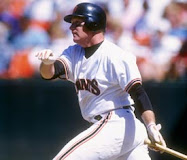
Sometimes you just get lucky. In 1995, I was able to see Tino Martinez hit the game winning home run for the Seattle Mariners at the Kingdome off Dennis Eckersley in the bottom of the ninth. In 2005, I saw Adam Morrison bank in the game winning shot against Oklahoma State in Seattle.
You don't really anticipate great moments. They just happen.
Tonight was one of those moments.
When my Dad got tickets to tonight's game a few days ago, he didn't know Buster Posey was going to make his debut against the Diamondbacks on May 29th. I didn't know either. Heck, nobody except Brian Sabean and his management team knew really.
Nonetheless, Posey was making his debut and my Mom, Dad and I were lucky to see it.
Here is a breakdown of Posey's debut, "diary" style.
Lineup announcements
I like the lineup announcements at AT&T Park for some reason. They always have cool music. Juan Uribe always has a "money" look on his face when he turns to the camera. Bruce Bochy always looks awkward. And this year, they had these special effects where it looked like some kind of "techno" thing (more on this later).
Anyways, the lineup announcements went as usual. With the big guys (e.g. Pablo Sandoval and Uribe) getting the big cheers and the other (e.g. Aaron Rowand and Eli Whiteside) getting slightly better than golf clap support.
When Posey's name was announced in the sixth spot, however, the crowd roared. Last year, I attended Ryan Garko's first game as a Giant (not exactly witnessing greatness there), and he didn't get close to the response Posey received. You knew it was going to be a special day judging by the crowd's response to Posey. Even a guy who had been subdued thirty minutes before the game, seemingly drained from having to chaperon his daughter and their two friends, went ballistic when Posey was announced.
Top of the first inning, first batter
Kelly Johnson hits a bullet down the first base line. Posey makes a dive, but he's too off the line to make a play. You can hear some worry in the crowd after the play, as if everyone is thinking "Oh crap, maybe putting Buster at first wasn't the best idea." Thankfully, nothing comes out of it, as Jonathan Sanchez pitches his characteristic "20- plus pitch, but without any damage" inning.
Bottom of the first, Posey's first at-bat
There are runners on first and second when Posey gets up to the plate. The whole place gives him a huge standing ovation. Seriously, I don't think I have seen any Giant this young have this much anticipation. Sure, Lincecum was hyped, but he looked good down the stretch in 2007, so you knew he was going to bring good things in 2008. Pablo Sandoval was a relative surprise, so we didn't have the anticipation time. Posey blows this out of the water. He's probably the third most exciting player to Giants fans behind Lincecum and Sandoval. And yes, he hasn't taken an at-bat this year until today.
Posey works the count to 1-1, looking calm and collected at the plate. On the next pitch, he stays behind the ball and laces a line drive single up the middle. Sanchez scores from second and the crowd goes ballistic. You couldn't have asked for more from Posey in his first at-bat this year. Patient, makes good contact, easy swing, and drives in a run. Can't say we've seen that a lot from other Giants hitters this year (cough...Bengie Molina...cough).
(Notice I have to say this year after everything; it's funny, because it feels like a Major League debut when it really isn't considering he had a wee bit of playing time last September. I am also the 100th person to make this observation.)
Bottom of the third, Posey's second at-bat
It's "kid announces the lineup" inning, and he does a good job for the first couple of batters. Nails the "UUUURIBBE" and everything. However, Uribe knocks in a home run and it throws the kid in a loop and he isn't able to announce Posey's name, which ruins the moment of his second at-bat. Ironically, the only time they don't announce his name at the plate, Posey flies out to right.
Surprisingly, it is one of the most exciting pop ups all day. Considering the hype after his first hit, along with the Uribe home run on the previous at-bat, the crowd is ready to explode. As soon as the ball in the air, people get up immediately thinking it has a shot of going out. Whiteside hits that ball and people are thinking about heading to the Doggie Diner to stand in line for a nine dollar beer.
Bottom of the fifth, Posey's third at-bat
Posey's best at-bat of the day. With the bases load, he takes two pitches and milks the count to 2-0. He gets a fastball but he shrugs it off to make the count 2-1. On the next pitch he sees a breaking ball and drives it up the middle for a single. The crowd goes ballistic again. Posey is making this look so easy, as if he is playing pepper with the Arizona pitching staff. A.J. Hinch changes pitchers after Posey's single makes it five to zero.
Posey's already earned Player of the Game honors and the game isn't even over. That's how big he has been today. In three at-bats at this point, he has two hits and two RBI. All in his 2010 debut. I guess Triple-A stats mean something, right Sabes?
Top of the Sixth
In the beginning of the sixth, Stephen Drew hits a groundball to Posey. Posey fields it cleanly, but kind of does a "should I toss or run to the bag" thing. The action kind of throws off Romo, who runs to the bag anyways. Posey at the last minutes tosses the ball to the covering Romo. They make the out, but Drew steps on Romo's foot in the process. Romo is pissed and yells as he walks it off. Two interesting things happen:
1.) Posey says nothing to Romo, as if he knows Romo is pissed off at him for waiting so long to make up his mind (Posey says this in the postgame on KNBR) and he doesn't want to invoke anything else and 2.) no training staff sees Romo after the out, though it's obvious he was stepped on. Seriously, I thought training staffs were supposed to look at every little thing?
The more important moment of the inning? The Giants have on the video a "Pump your first" inning. What makes it better is the clips from "Jersey Shore" mixed in with shots of fans pumping their fists to a song "Pump your fist" around the stadium. Ironically, this isn't the first "Jersey Shore" reference at AT&T Park today (Lincecum says Mark Derosa would be the best teammate to be on "Shore"). I find it amazing how this MTV show has penetrated Major League Baseball this year, from The Situation's Vitamin Water commercial with David Wright to the "Pump your fist" inning at AT&T Park.
Oh, I'm not complaining about any of this by the way.
Bottom of the seventh, Posey's fourth at-bat
Runners on second and third and Posey is up again. After taking a first called strike, Posey laces the next pitch between the third baseman and shortstop for a single. Sandoval scores and Posey has his third hit of the day. As Posey takes off his gloves at first base, he is greeted again by first base coach Roberto Kelly who has a look on his face that says "And we kept you HOW LONG in Fresno?" This Kelly face however is topped later in the inning after Denny Bautista's hit. After Bautista's "swing from your shoes and pray to God the ball hits your bat" hit, Kelly greets the reliever at first with a look that says "You have to give Rowand a hard time when you get back in the dugout."
Overall, you couldn't be happier with Posey's debut. Three hits, three RBI and some solid defense at first. Granted, I still want him to catcher, but Posey is athletic enough to play the position for the time being. Then again, I'm not worried about Posey's defense right now. He is hitting, and if he can spark the Giants offense like he did tonight, then well...the Giants will be thankful they called up Posey sooner than they wanted to.
Showing posts with label Arizona Diamondbacks. Show all posts
Showing posts with label Arizona Diamondbacks. Show all posts
Sunday, May 30, 2010

Thursday, April 1, 2010
"Giants" Enemy Lines: The NL West Preview
It's finally here. I'm sorry for the delay. It's been tough balancing two blogs (this and 500 Days of Zobrist, the fantasy baseball blog) so I've kind of slacked a little the past week on posts here at Remember '51.
However, here is Remember '51's complete NL West Preview, with each team by team breakdown (including your very own San Francisco Giants).
Arizona Diamondbacks
2009 results: 70-92 (last in the NL West).
2010 projections: 82-80 (PECOTA; tied for third in NL West)
The Diamondbacks in 2009
The Diamondbacks suffered a huge letdown season last year after finishing second in the division in 2008, and making the playoffs in 2007. The main problems for Arizona last season? Management change, injuries and general ineffectiveness by their players.
First off, Arizona changed managers last season after 29 games, firing manager Bob Melvin and replacing him with A.J. Hinch, the Diamondbacks' farm director at the time. The move was surprising because a.) Hinch had no managerial experience at the time, and b.) it seemed he was being groomed to be a future "general" manager rather than a "field" manager (hence, him working as the manager of minor league operations).
Well, the relationship never really clicked, and the Diamondbacks tanked. It wasn't completely his fault tho. Brandon Webb went down to injury, and promising players like Chris Young, Chad Tracy, Conor Jackson and even Stephen Drew all had down years. Dan Haren had another solid campaign, and Justin Upton, Mark Reynolds and Miguel Montero all showed promise of being future stars, but for the most part, the Diamondbacks didn't get a whole lot of consistent contribution from their roster, hence their last place finish in 2009.
Why the Diamondbacks Can Be Good in 2010
The young talent is in place. Though Drew is coming off a bad year, he certainly has enough promise to bounce back to his 2008 form (.291 average, 21 home runs, .836 OPS, 13.6 wRAA in 2008), and his plate approach was actually better in 2009 (0.56 BB/K ratio in 2009 in comparison to 0.38 ratio in 2008). Also, Haren and Upton are studs. Reynolds, Webb and Montero are big question marks, but if they continue to progress, they could have real impact on this team in 2010.
Furthermore, the Diamondbacks made some interesting moves that could work out for better. Edwin Jackson definitely is a talent, and made a step last year in Detroit to prove that he is on the cusp of being one of the game's better pitchers. Also, the acquisition of Ian Kennedy also adds depth to their starting rotation, something they didn't really have in 2009. If the hitting can bounce back, the pitching will look a whole lot better in 2010 than in 2009, which consequently will have a big effect on their record.
Why the Diamondbacks Might Be Bad in 2010
A lot of question marks surround this team. Can A.J. Hinch manage this ballclub after failing to motivate them in 2009? Can Brandon Webb be healthy? Can Dan Haren get some run support? Is Chad Qualls a top-tier closer or just another good reliever? Is Mark Reynolds a one-year wonder or a consistent power threat? Can Justin Upton carry this offense? Can Stephen Drew return to 2008 form? Can Edwin Jackson repeat his first-half stats in 2009 over the course of a full-season?
In my mind, the Diamondbacks have more questions than any other team in the NL West. So, while the Diamondbacks have potential to be solid players in the National League race, they could also fall apart as easily as last year if a lot of their players don't bounce back and produce.
What's my gut feeling about a lot of these questions? I don't think Webb will be back to his Cy-Young form, I think Reynolds won't repeat his 2009 numbers, I think Jackson is good but not great (Max Scherzer was a much better fit for this team), and Haren will get more run support than in 2009, but not that much.
Remember '51 Projection: 78-84 (fourth in the NL West)
The Diamondbacks have an interesting pitching core in Haren, Webb, Jackson and Kennedy and an even more interesting offensive core in Montero, Reynolds, Upton and Drew. My main beef is that I can't get a good read on these players. In my opinion, I think half of these "core" guys will flourish (Upton, Drew, Haren) and half will most likely not (Reynolds, Webb, Kennedy). So, I think Diamondbacks will flounder around .500 the whole year. They won't be out of it early, but they won't be serious contenders like a lot of people think.
Colorado Rockies
2009 results: 92-70 (second in NL West; NL Wild-Card winners)
2010 projections: 86-76 (PECOTA; first in NL West)
The Rockies in 2009
The Rockies were a tale of two teams last year: the team under Clint Hurdle, and the team post-Clint Hurdle.
To start off the year, the Rockies seemed to be a tremendous disappointment. At the time of Hurdle's firing, the Rockies were 18-28 and many thought general manager Dan O'Dowd was in the midst of another rebuilding season in Colorado.
Then Jim Tracy took over, the Rockies got hot, and eventually took second place from the San Francisco Giants, as well as the NL Wild Card spot. Though the Phillies bounced the Rockies in the NLDS, it was a successful season for the Rockies, who got big-time performances from hitters Troy Tulowitzki, Brad Hawpe, Dexter Fowler, Carlos Gonzalez, and Ian Stewart and solid pitching seasons from Ubaldo Jimenez, Aaron Cook, Jorge de la Rosa, Huston Street, and Jason Marquis.
Why the Rockies Can Be Good in 2010
The Rockies have a chance to be not only contenders in the NL West, but perhaps in Major League baseball as well. They return their entire, young core from last year, and shed all the spare parts they didn't need (Garrett Atkins) this off-season. Furthermore, the Rockies will also welcome back Jeff Francis, one of the Rockies' aces in 2007, who is coming back after missing the entire 2009 season to injury.
The Rockies lineup will be absolutely stacked, especially in outfielder where Gonzalez will play left, Fowler center, and Hawpe right. While Hawpe may be a detriment to the Rockies defensively, no baseball fan can doubt the offensive potency of that trio in the lineup.
There are some question marks with the pitching staff (mostly concerning de la Rosa and his high walk rates). However, Rockies fans have to be happy with the progress of Ubaldo Jimenez, who had the highest VORP (value over replacement player) of any pitcher on the Rockies staff last year according to Baseball Prospectus.
Why the Rockies Might Be Bad in 2010
If there is one thing you can say about the Rockies it is this: they don't necessarily have a track record for consistency. After winning the NL Pennant in 2007, the Rockies tanked in 2008, going 74-88. Could the same be in store for them in 2010? Sure, they have a new manager in Tracy, but one has to wonder if the Rockies are the kind of franchise that can put together back-to-back solid seasons. In their short history, they haven't necessarily proven that.
To make matters worse, the Rockies are dealing with some serious issues in the pitching category, especially at closer. Huston Street was shut-down this Spring, and most likely will begin the season on the Disabled List. Now, he could be back by May 1, but one has to wonder: can Street do what he did for the Rockies last year? Or are we going to see a Brad Lidge-esque trend? (e.g. solid one year, terrible the next).
Last year was a very surprising season for Street that might be hard to duplicate. Additionally, there isn't too much depth in the Rockies bullpen either (Franklin Morales is slated to be the temporary closer). If there is one thing that is required for a successful season, a solid bullpen is it, and unfortunately for Rockies fans, you can't necessarily say that of Colorado at this point.
Remember '51 Projection: 86-76 (first in the NL West)
The Rockies have question marks galore with their bullpen, and a few question marks with their starting pitching (how healthy is Francis? Can de la Rosa duplicate his 2009 numbers, but improve his walk stats?). Nonetheless, from top-to-bottom, the Rockies are pretty solid, and I consider them to be the favorite to win the NL West. Offensively, they look dynamite. Tulowitzki is the real deal, and Hawpe could prove to be a stud over his career as well. The players with the biggest upside though are Fowler and Gonzalez, who could experience real breakout season now that they will be expected to be playing full time in Colorado.
Los Angeles Dodgers
2009 results: (95-67, 1st in the NL West; NLCS runner-ups)
2010 projections: (83-79, PECOTA; second in the NL West)
The Dodgers in 2009
The Dodgers got off to a hot start in 2009 and never looked back. Matt Kemp and Andre Ethier broke into superstar status in Los Angeles, and Jonathan Broxton delivered in his first full-season as Dodgers closer. While Manny Ramirez didn't live up to expectations after coming back from a 50-game suspension to start off the season, free agent pickup Orlando Hudson picked up the slack en route to an All-Star appearance and his fourth Gold Glove at the end of the season.
While the Dodgers didn't have a strong ace for most of the year, they got a pleasant surprise in Clayton Kershaw, who had the highest VORP of any Dodgers pitcher in 2009 (Randy Wolf was second). While the Dodgers lost Wolf, Kershaw and Chad Billingsley, who had a solid first-half last year, return as well as Vicente Padilla, their Opening Day starter this year, who performed admirably (4-0, 1.22 WHIP, 3.20 ERA) after being acquired from Texas last season.
Why the Dodgers Can Be Good in 2010
They have Kemp back. They have Ethier back. They have Manny back. The solid trio of slugging outfielders return and the National League West should take notice. Yes, the Dodgers didn't make many upgrades this off-season, but when you have those three as your three-four-five hitters, you don't really need to hit free agency that hard.
Also, the bullpen is scary (even if they aren't completely healthy). Broxton is a stud, and George Sherrill, a former closer with the Baltimore Orioles, is a solid left-handed compliment. The Dodgers also have two solid young arms in the rotation in Kershaw and Billingsley, both who had great stretches during the season in 2009. If they can get a hold of their command in 2010, Kershaw and Billingsley could be one of the NL-West's better one-two punches.
Why the Dodgers Could Be Bad in 2010
There is a lot against the Dodgers going into Opening Day. First off, the McCourt divorce is proving to be a huge distraction, and as Frank and Jamie sling mud, lawyers and money at each other, one has to wonder who the heck is running the ballclub for the time being. The Dodgers were already hit-hard this off-season because of Frank and Jamie's messy dealings, will the same be true during the season when they are in need of a pitching upgrade?
Furthermore, age is a concern for many of the players on the Dodgers roster. Manny seems to be in regression, as does Casey Blake, as does Russell Martin, as does Rafael Furcal. Sure, the Dodgers have a great core in Kemp and Etheir, but other than that, their offense seems to be a little shaky at this point. James Loney hasn't really prove to be anything special, lord knows how Blake DeWitt will fare over a full Major League season, and one has to wonder about their outfield depth, which was hit hard by the departure of Juan Pierre to the Chicago White Sox. I guarantee you, Pierre will be missed once the Dodgers reach mid-season.
Remember '51 Projection: 81-81 (third in the NL West)
The Dodgers look to be in regression as a team, and the McCourt divorce certainly doesn't help their situation either. Maybe Manny has one more good season left in him. Maybe Loney will reach his potential this year like Kemp last season. Maybe Billingsley will get his control problems panned out. Maybe Kershaw will develop a third pitch.
I'm sorry...I know I'm biased as a Giants fan, but I just don't see a whole lot of optimism with this 2010 Dodgers squad.
San Francisco Giants
2009 results 88-74 (third in the NL West)
2010 projections: 82-80 (PECOTA; tied for third in the NL West)
The Giants in 2009
The Giants were expected to continue their rebuilding process in the post-Barry Bonds era in 2009. Well...the rebuilding process finished sooner than expected, as the Giants raced off to a hot start and stayed in the NL Wild Card race the entire year. While the Giants didn't get a lot of help offensively (they finished in or near the bottom of the NL in most major categories such as OPS, OBP and runs scored), the pitching made up for their offensive deficiencies. Tim Lincecum won his second Cy Young, Matt Cain made the NL All-Star team, Brian Wilson improved from 2008, Barry Zito finally showed he was worth a semblance of the contracts he was given in 2007, and Jonathan Sanchez showed some promise by throwing the first Giants no-hitter since John Montefusco.
Granted, the offense was not a complete bust. Pablo "Kung Fu Panda" Sandoval proved to be the most exciting Giants third baseman since Matt Williams as he slugged 25 home runs, hit .330, and sported a VORP of 64.2 (almost 40 points higher than the next-best Giants hitter, Juan Uribe, who had a VORP of 25.7). The Giants had a lot of problems getting consistent offensive production from their lineup. Thankfully, Sandoval wasn't one of the problems.
Why the Giants Can Be Good in 2010
It's not just the Sandoval and Co. show anymore. Though one can question how good the moves were financially, Giants fans can't accuse general manager Brian Sabean of not putting out any effort to improve the Giants offense this off-season. Sabean signed Mark Derosa from the St. Louis Cardinals and Aubrey Huff from the Detroit Tigers, and also managed to re-sign Uribe (as insurance should Edgar Renteria flounder a second-straight year), Freddy Sanchez and Bengie Molina. There are some questions concerning the direction the Giants are taking as an organization (are they going young or are they still trying the old "plug and chug" model of building a ballclub?) but any Giants fan can admit that the Giants' Opening Day lineup looks a whole lot more promising in 2010 than in 2009.
As for the pitching? They return their top-four starters from last season, they return their top-three bullpen arms (Wilson, Jeremy Affeldt and Sergio Romo), they added a fifth starter who has had a marvelous Spring (Todd Wellemeyer), and they have a Top-10 prospect (Madison Bumgarner) waiting in the wings should that "Spring Star" prove to be a dud during the regular season.
Yes, it's safe to say, things are good on the pitching end for the Giants.
Why the Giants Could Be Bad in 2010
They did their "best" to address their power need this off-season by signing 20-homer guys Huff and Derosa. However, there still are major concerns about this Giants lineup.
They have Aaron Rowand penciled in to bat leadoff.
They have only one guy returning with an OBP over .350 (Sandoval) and the guy with the second-highest OBP (Fred Lewis) is on the verge of being released.
F. Sanchez will begin the season on the DL.
Thus, it's tough to say that the Giants are in a "much" better situation in 2010 than in 2009. They have an older roster, a lot of their players (Molina, Derosa, Huff, Sanchez, Rowand) have already reached their peaks as players, and a lot of the promising young guys (Buster Posey for example) seem to be blocked unless major injury or major moves should happen during the year.
In many ways, Sabean had a chance to really improve the Giants roster this season and set them up well for the future. Instead, it looks like he just speckled problems (need for offense) with plaster (Derosa, Molina and Huff signings) that will wear off sooner than expected.
Remember '51 Projection: 83-79 (second in the NL West)
I know I have been a negative Nancy about the Giants for the most part this off-season. However, at the core, I think this Giants team is a good enough team, and the NL West is vulnerable enough for the Giants to make a run. The Dodgers aren't the same Dodgers in 2009 and won't be the 2009 Dodgers with this McCourt Divorce hanging over them. The Diamondbacks, in my mind, could be a dark horse should Webb be healthy, but if he isn't, I seriously doubt they'll be major contenders. San Diego is San Diego.
The opportunity is there. All the stands in the way is the Rockies, and despite their great young talent, they don't have a history of repeated success.
That's what makes me hopeful about the Giants this season, but I'm not going to jump the gun and give them the NL West yet. However, I won't be surprised if the pull it off.
San Diego Padres
2009 results: 75-87 (fourth place in the NL West)
2010 projections: 73-89 (fifth place in the NL West)
The Padres in 2009
Widely maligned as a laughingstock earlier in the season, the Padres actually turned it around at the end of the year and turned out to be a pretty decent ballclub, despite their poor start. Adrian Gonzalez proved to be a stud once again, and the Padres got relative breakout years from position players like Everth Cabrera (14.8 VORP, fourth-highest on the team), Chase Headley (15.1 VORP, third-highest on the team), Will Venable (12 home runs, 38 RBI, 10.3 VORP), and Kyle Blanks (10 home runs in 172 plate appearances, 10.0 VORP). Also, Giants castoff Kevin Correia also proved to be a breakout of sorts as he posted the highest VORP out of any pitcher on the team (24.9) and Heath Bell proved to be a viable closer as the he made the NL All-Star team and saved 42 games.
Why the Padres Can Be Good in 2010
Kevin Towers and his questionable general manager ways (picking Matt Bush No.1 overall over Justin Verlander, Billy Butler and Stephen Drew, giving Brian Giles a "no-trade" clause in his contract, etc.) are gone and the Padres have a good young core in place to compete. Venable and Blanks weren't spectacular in 2009, but they certainly have the potential to breakout in 2010. Headly proved to be a very solid player down the stretch, and Cabrera might be one of the games most underrated shortstops.
Add that with a solid closer (Bell_, one of the best hitters in the game (Gonzalez) and manager with a good reputation (Bud Black, who actually garnered some Manager of the Year votes), and the Padres have the chance to be successful in 2010 in a Tampa Bay Rays or Florida Marlins mold.
Why the Padres Might Be Bad in 2010
They have a good young core offensively, but there are serious issues in their pitching department. Jon Garland is their No. 1 starter. Jon "Freaking" Garland! That is not good sign for your ballclub.
To make matters worse, it only seems to be a matter of time before Gonzalez is traded. For the Padres to have playoff hopes, they need Gonzalez, and at this point, having him for more than two months seems to be a luxury.
The Padres are young and talented, but they seem too young at this point to compete, even in the "free-for-all" NL West.
Remember '51 Projection: 72-90 (fifth in the NL West)
The Padres could be good in 2011 or 2012. However, they just don't seem to have enough pitching and their young talent seems to be a bit too unproven at this point in order to be a contender. I like what the Padres are doing as an organization, but they just don't have the horses to compete for a playoff spot. Most likely, it's going to be a long, tough year for Padres fans, and it will only get worse when Adrian Gonzalez leaves.
However, here is Remember '51's complete NL West Preview, with each team by team breakdown (including your very own San Francisco Giants).
Arizona Diamondbacks
2009 results: 70-92 (last in the NL West).
2010 projections: 82-80 (PECOTA; tied for third in NL West)
The Diamondbacks in 2009
The Diamondbacks suffered a huge letdown season last year after finishing second in the division in 2008, and making the playoffs in 2007. The main problems for Arizona last season? Management change, injuries and general ineffectiveness by their players.
First off, Arizona changed managers last season after 29 games, firing manager Bob Melvin and replacing him with A.J. Hinch, the Diamondbacks' farm director at the time. The move was surprising because a.) Hinch had no managerial experience at the time, and b.) it seemed he was being groomed to be a future "general" manager rather than a "field" manager (hence, him working as the manager of minor league operations).
Well, the relationship never really clicked, and the Diamondbacks tanked. It wasn't completely his fault tho. Brandon Webb went down to injury, and promising players like Chris Young, Chad Tracy, Conor Jackson and even Stephen Drew all had down years. Dan Haren had another solid campaign, and Justin Upton, Mark Reynolds and Miguel Montero all showed promise of being future stars, but for the most part, the Diamondbacks didn't get a whole lot of consistent contribution from their roster, hence their last place finish in 2009.
Why the Diamondbacks Can Be Good in 2010
The young talent is in place. Though Drew is coming off a bad year, he certainly has enough promise to bounce back to his 2008 form (.291 average, 21 home runs, .836 OPS, 13.6 wRAA in 2008), and his plate approach was actually better in 2009 (0.56 BB/K ratio in 2009 in comparison to 0.38 ratio in 2008). Also, Haren and Upton are studs. Reynolds, Webb and Montero are big question marks, but if they continue to progress, they could have real impact on this team in 2010.
Furthermore, the Diamondbacks made some interesting moves that could work out for better. Edwin Jackson definitely is a talent, and made a step last year in Detroit to prove that he is on the cusp of being one of the game's better pitchers. Also, the acquisition of Ian Kennedy also adds depth to their starting rotation, something they didn't really have in 2009. If the hitting can bounce back, the pitching will look a whole lot better in 2010 than in 2009, which consequently will have a big effect on their record.
Why the Diamondbacks Might Be Bad in 2010
A lot of question marks surround this team. Can A.J. Hinch manage this ballclub after failing to motivate them in 2009? Can Brandon Webb be healthy? Can Dan Haren get some run support? Is Chad Qualls a top-tier closer or just another good reliever? Is Mark Reynolds a one-year wonder or a consistent power threat? Can Justin Upton carry this offense? Can Stephen Drew return to 2008 form? Can Edwin Jackson repeat his first-half stats in 2009 over the course of a full-season?
In my mind, the Diamondbacks have more questions than any other team in the NL West. So, while the Diamondbacks have potential to be solid players in the National League race, they could also fall apart as easily as last year if a lot of their players don't bounce back and produce.
What's my gut feeling about a lot of these questions? I don't think Webb will be back to his Cy-Young form, I think Reynolds won't repeat his 2009 numbers, I think Jackson is good but not great (Max Scherzer was a much better fit for this team), and Haren will get more run support than in 2009, but not that much.
Remember '51 Projection: 78-84 (fourth in the NL West)
The Diamondbacks have an interesting pitching core in Haren, Webb, Jackson and Kennedy and an even more interesting offensive core in Montero, Reynolds, Upton and Drew. My main beef is that I can't get a good read on these players. In my opinion, I think half of these "core" guys will flourish (Upton, Drew, Haren) and half will most likely not (Reynolds, Webb, Kennedy). So, I think Diamondbacks will flounder around .500 the whole year. They won't be out of it early, but they won't be serious contenders like a lot of people think.
Colorado Rockies
2009 results: 92-70 (second in NL West; NL Wild-Card winners)
2010 projections: 86-76 (PECOTA; first in NL West)
The Rockies in 2009
The Rockies were a tale of two teams last year: the team under Clint Hurdle, and the team post-Clint Hurdle.
To start off the year, the Rockies seemed to be a tremendous disappointment. At the time of Hurdle's firing, the Rockies were 18-28 and many thought general manager Dan O'Dowd was in the midst of another rebuilding season in Colorado.
Then Jim Tracy took over, the Rockies got hot, and eventually took second place from the San Francisco Giants, as well as the NL Wild Card spot. Though the Phillies bounced the Rockies in the NLDS, it was a successful season for the Rockies, who got big-time performances from hitters Troy Tulowitzki, Brad Hawpe, Dexter Fowler, Carlos Gonzalez, and Ian Stewart and solid pitching seasons from Ubaldo Jimenez, Aaron Cook, Jorge de la Rosa, Huston Street, and Jason Marquis.
Why the Rockies Can Be Good in 2010
The Rockies have a chance to be not only contenders in the NL West, but perhaps in Major League baseball as well. They return their entire, young core from last year, and shed all the spare parts they didn't need (Garrett Atkins) this off-season. Furthermore, the Rockies will also welcome back Jeff Francis, one of the Rockies' aces in 2007, who is coming back after missing the entire 2009 season to injury.
The Rockies lineup will be absolutely stacked, especially in outfielder where Gonzalez will play left, Fowler center, and Hawpe right. While Hawpe may be a detriment to the Rockies defensively, no baseball fan can doubt the offensive potency of that trio in the lineup.
There are some question marks with the pitching staff (mostly concerning de la Rosa and his high walk rates). However, Rockies fans have to be happy with the progress of Ubaldo Jimenez, who had the highest VORP (value over replacement player) of any pitcher on the Rockies staff last year according to Baseball Prospectus.
Why the Rockies Might Be Bad in 2010
If there is one thing you can say about the Rockies it is this: they don't necessarily have a track record for consistency. After winning the NL Pennant in 2007, the Rockies tanked in 2008, going 74-88. Could the same be in store for them in 2010? Sure, they have a new manager in Tracy, but one has to wonder if the Rockies are the kind of franchise that can put together back-to-back solid seasons. In their short history, they haven't necessarily proven that.
To make matters worse, the Rockies are dealing with some serious issues in the pitching category, especially at closer. Huston Street was shut-down this Spring, and most likely will begin the season on the Disabled List. Now, he could be back by May 1, but one has to wonder: can Street do what he did for the Rockies last year? Or are we going to see a Brad Lidge-esque trend? (e.g. solid one year, terrible the next).
Last year was a very surprising season for Street that might be hard to duplicate. Additionally, there isn't too much depth in the Rockies bullpen either (Franklin Morales is slated to be the temporary closer). If there is one thing that is required for a successful season, a solid bullpen is it, and unfortunately for Rockies fans, you can't necessarily say that of Colorado at this point.
Remember '51 Projection: 86-76 (first in the NL West)
The Rockies have question marks galore with their bullpen, and a few question marks with their starting pitching (how healthy is Francis? Can de la Rosa duplicate his 2009 numbers, but improve his walk stats?). Nonetheless, from top-to-bottom, the Rockies are pretty solid, and I consider them to be the favorite to win the NL West. Offensively, they look dynamite. Tulowitzki is the real deal, and Hawpe could prove to be a stud over his career as well. The players with the biggest upside though are Fowler and Gonzalez, who could experience real breakout season now that they will be expected to be playing full time in Colorado.
Los Angeles Dodgers
2009 results: (95-67, 1st in the NL West; NLCS runner-ups)
2010 projections: (83-79, PECOTA; second in the NL West)
The Dodgers in 2009
The Dodgers got off to a hot start in 2009 and never looked back. Matt Kemp and Andre Ethier broke into superstar status in Los Angeles, and Jonathan Broxton delivered in his first full-season as Dodgers closer. While Manny Ramirez didn't live up to expectations after coming back from a 50-game suspension to start off the season, free agent pickup Orlando Hudson picked up the slack en route to an All-Star appearance and his fourth Gold Glove at the end of the season.
While the Dodgers didn't have a strong ace for most of the year, they got a pleasant surprise in Clayton Kershaw, who had the highest VORP of any Dodgers pitcher in 2009 (Randy Wolf was second). While the Dodgers lost Wolf, Kershaw and Chad Billingsley, who had a solid first-half last year, return as well as Vicente Padilla, their Opening Day starter this year, who performed admirably (4-0, 1.22 WHIP, 3.20 ERA) after being acquired from Texas last season.
Why the Dodgers Can Be Good in 2010
They have Kemp back. They have Ethier back. They have Manny back. The solid trio of slugging outfielders return and the National League West should take notice. Yes, the Dodgers didn't make many upgrades this off-season, but when you have those three as your three-four-five hitters, you don't really need to hit free agency that hard.
Also, the bullpen is scary (even if they aren't completely healthy). Broxton is a stud, and George Sherrill, a former closer with the Baltimore Orioles, is a solid left-handed compliment. The Dodgers also have two solid young arms in the rotation in Kershaw and Billingsley, both who had great stretches during the season in 2009. If they can get a hold of their command in 2010, Kershaw and Billingsley could be one of the NL-West's better one-two punches.
Why the Dodgers Could Be Bad in 2010
There is a lot against the Dodgers going into Opening Day. First off, the McCourt divorce is proving to be a huge distraction, and as Frank and Jamie sling mud, lawyers and money at each other, one has to wonder who the heck is running the ballclub for the time being. The Dodgers were already hit-hard this off-season because of Frank and Jamie's messy dealings, will the same be true during the season when they are in need of a pitching upgrade?
Furthermore, age is a concern for many of the players on the Dodgers roster. Manny seems to be in regression, as does Casey Blake, as does Russell Martin, as does Rafael Furcal. Sure, the Dodgers have a great core in Kemp and Etheir, but other than that, their offense seems to be a little shaky at this point. James Loney hasn't really prove to be anything special, lord knows how Blake DeWitt will fare over a full Major League season, and one has to wonder about their outfield depth, which was hit hard by the departure of Juan Pierre to the Chicago White Sox. I guarantee you, Pierre will be missed once the Dodgers reach mid-season.
Remember '51 Projection: 81-81 (third in the NL West)
The Dodgers look to be in regression as a team, and the McCourt divorce certainly doesn't help their situation either. Maybe Manny has one more good season left in him. Maybe Loney will reach his potential this year like Kemp last season. Maybe Billingsley will get his control problems panned out. Maybe Kershaw will develop a third pitch.
I'm sorry...I know I'm biased as a Giants fan, but I just don't see a whole lot of optimism with this 2010 Dodgers squad.
San Francisco Giants
2009 results 88-74 (third in the NL West)
2010 projections: 82-80 (PECOTA; tied for third in the NL West)
The Giants in 2009
The Giants were expected to continue their rebuilding process in the post-Barry Bonds era in 2009. Well...the rebuilding process finished sooner than expected, as the Giants raced off to a hot start and stayed in the NL Wild Card race the entire year. While the Giants didn't get a lot of help offensively (they finished in or near the bottom of the NL in most major categories such as OPS, OBP and runs scored), the pitching made up for their offensive deficiencies. Tim Lincecum won his second Cy Young, Matt Cain made the NL All-Star team, Brian Wilson improved from 2008, Barry Zito finally showed he was worth a semblance of the contracts he was given in 2007, and Jonathan Sanchez showed some promise by throwing the first Giants no-hitter since John Montefusco.
Granted, the offense was not a complete bust. Pablo "Kung Fu Panda" Sandoval proved to be the most exciting Giants third baseman since Matt Williams as he slugged 25 home runs, hit .330, and sported a VORP of 64.2 (almost 40 points higher than the next-best Giants hitter, Juan Uribe, who had a VORP of 25.7). The Giants had a lot of problems getting consistent offensive production from their lineup. Thankfully, Sandoval wasn't one of the problems.
Why the Giants Can Be Good in 2010
It's not just the Sandoval and Co. show anymore. Though one can question how good the moves were financially, Giants fans can't accuse general manager Brian Sabean of not putting out any effort to improve the Giants offense this off-season. Sabean signed Mark Derosa from the St. Louis Cardinals and Aubrey Huff from the Detroit Tigers, and also managed to re-sign Uribe (as insurance should Edgar Renteria flounder a second-straight year), Freddy Sanchez and Bengie Molina. There are some questions concerning the direction the Giants are taking as an organization (are they going young or are they still trying the old "plug and chug" model of building a ballclub?) but any Giants fan can admit that the Giants' Opening Day lineup looks a whole lot more promising in 2010 than in 2009.
As for the pitching? They return their top-four starters from last season, they return their top-three bullpen arms (Wilson, Jeremy Affeldt and Sergio Romo), they added a fifth starter who has had a marvelous Spring (Todd Wellemeyer), and they have a Top-10 prospect (Madison Bumgarner) waiting in the wings should that "Spring Star" prove to be a dud during the regular season.
Yes, it's safe to say, things are good on the pitching end for the Giants.
Why the Giants Could Be Bad in 2010
They did their "best" to address their power need this off-season by signing 20-homer guys Huff and Derosa. However, there still are major concerns about this Giants lineup.
They have Aaron Rowand penciled in to bat leadoff.
They have only one guy returning with an OBP over .350 (Sandoval) and the guy with the second-highest OBP (Fred Lewis) is on the verge of being released.
F. Sanchez will begin the season on the DL.
Thus, it's tough to say that the Giants are in a "much" better situation in 2010 than in 2009. They have an older roster, a lot of their players (Molina, Derosa, Huff, Sanchez, Rowand) have already reached their peaks as players, and a lot of the promising young guys (Buster Posey for example) seem to be blocked unless major injury or major moves should happen during the year.
In many ways, Sabean had a chance to really improve the Giants roster this season and set them up well for the future. Instead, it looks like he just speckled problems (need for offense) with plaster (Derosa, Molina and Huff signings) that will wear off sooner than expected.
Remember '51 Projection: 83-79 (second in the NL West)
I know I have been a negative Nancy about the Giants for the most part this off-season. However, at the core, I think this Giants team is a good enough team, and the NL West is vulnerable enough for the Giants to make a run. The Dodgers aren't the same Dodgers in 2009 and won't be the 2009 Dodgers with this McCourt Divorce hanging over them. The Diamondbacks, in my mind, could be a dark horse should Webb be healthy, but if he isn't, I seriously doubt they'll be major contenders. San Diego is San Diego.
The opportunity is there. All the stands in the way is the Rockies, and despite their great young talent, they don't have a history of repeated success.
That's what makes me hopeful about the Giants this season, but I'm not going to jump the gun and give them the NL West yet. However, I won't be surprised if the pull it off.
San Diego Padres
2009 results: 75-87 (fourth place in the NL West)
2010 projections: 73-89 (fifth place in the NL West)
The Padres in 2009
Widely maligned as a laughingstock earlier in the season, the Padres actually turned it around at the end of the year and turned out to be a pretty decent ballclub, despite their poor start. Adrian Gonzalez proved to be a stud once again, and the Padres got relative breakout years from position players like Everth Cabrera (14.8 VORP, fourth-highest on the team), Chase Headley (15.1 VORP, third-highest on the team), Will Venable (12 home runs, 38 RBI, 10.3 VORP), and Kyle Blanks (10 home runs in 172 plate appearances, 10.0 VORP). Also, Giants castoff Kevin Correia also proved to be a breakout of sorts as he posted the highest VORP out of any pitcher on the team (24.9) and Heath Bell proved to be a viable closer as the he made the NL All-Star team and saved 42 games.
Why the Padres Can Be Good in 2010
Kevin Towers and his questionable general manager ways (picking Matt Bush No.1 overall over Justin Verlander, Billy Butler and Stephen Drew, giving Brian Giles a "no-trade" clause in his contract, etc.) are gone and the Padres have a good young core in place to compete. Venable and Blanks weren't spectacular in 2009, but they certainly have the potential to breakout in 2010. Headly proved to be a very solid player down the stretch, and Cabrera might be one of the games most underrated shortstops.
Add that with a solid closer (Bell_, one of the best hitters in the game (Gonzalez) and manager with a good reputation (Bud Black, who actually garnered some Manager of the Year votes), and the Padres have the chance to be successful in 2010 in a Tampa Bay Rays or Florida Marlins mold.
Why the Padres Might Be Bad in 2010
They have a good young core offensively, but there are serious issues in their pitching department. Jon Garland is their No. 1 starter. Jon "Freaking" Garland! That is not good sign for your ballclub.
To make matters worse, it only seems to be a matter of time before Gonzalez is traded. For the Padres to have playoff hopes, they need Gonzalez, and at this point, having him for more than two months seems to be a luxury.
The Padres are young and talented, but they seem too young at this point to compete, even in the "free-for-all" NL West.
Remember '51 Projection: 72-90 (fifth in the NL West)
The Padres could be good in 2011 or 2012. However, they just don't seem to have enough pitching and their young talent seems to be a bit too unproven at this point in order to be a contender. I like what the Padres are doing as an organization, but they just don't have the horses to compete for a playoff spot. Most likely, it's going to be a long, tough year for Padres fans, and it will only get worse when Adrian Gonzalez leaves.
Thursday, March 4, 2010
Arizona's Edwin Jackson or the Giants' Matt Cain? Who's the Better Pitcher?
I am very intrigued by new Arizona Diamondbacks pitcher Edwin Jackson, who arrived from Detroit in a massive three-way trade this off-season (the New York Yankees, the third team, received Curtis Granderson). Jackson should be more than a familiar face to Giants fans. Last year, he made the American League All-Star team for Detroit, and he spent his first five years in professional ball in the Dodgers organization.
In many ways, Jackson was sort of a revelation last year. While he had been touted as a solid prospects during his Dodger days, he never really lived up to the expectations prior to 2009. He didn't get much opportunity in Los Angeles (he only pitched in 19 games for the Dodgers), and when he was traded to Tampa Bay, he struggled immensely.
In his three years with the Rays (2006-2008), he posted ERA numbers of 5.45, 5.76 and 4.42 and WHIP numbers of 1.84, 1.76 and 1.51. Granted, Jackson wasn't as bad as his record (19-26) or his ERA indicated in Tampa (his FIP numbers were 4.52, 4.90 and 4.88 with the Rays), but it was safe to say he wasn't the top prospect that everybody imagined during his Dodger days (he was rated the No. 4 prospect by Baseball America prior to the 2004 season).
However, Jackson turned it around Detroit, and suddenly, he became one of the hottest pitchers in baseball. Jackson went 13-9 with a 3.62 ERA and a 1.26 WHIP. When the Diamondbacks acquired him this off-season to pitch along with Dan Haren and Brandon Webb, many people deemed the Diamondbacks to have one of the most underrated rotations in baseball in 2010.
So what's Jackson have to do with Matt Cain?
In many ways, Cain and Jackson had very similar 2009 seasons. They were both guys who were better than their last couple of years prior to 2009 indicated, and they both had some skeptical numbers or qualities that made baseball fans and experts question whether or not they were as good as they were in the first half of the season in 2009. Furthermore, both Cain and Jackson had drop offs down the stretch, and both their teams barely missed out on the playoffs.
With these similarities between Cain and Jackson evident (almost creepy too), who is due to have the better 2010? Who is the better pitcher in general?
If you look at their overall profiles, it's easy to see that Cain is the better pitcher and not only is he due for another solid season in 2010, but Jackson may be primed for a dropoff in his first season in Arizona.
First off, Cain has had a better history of control and command of his pitches than Jackson. Yes, Jackson posted a better walk rate than Cain last year (2.94 to Cain's 3.02), but Cain posted a better BB/K ratio than Jackson last year (2.34 to Jackson's 2.30). To make matters worse for the new Diamondbacks pitcher, Jackson has struggled immensely in the past with walking hitters.
In 2008, Jackson posted a walk rate of 3.78. The season before that, his first year as a full-time starter for the Rays, he had a walk rate of 4.92.
As for Cain? He posted a walk rate of 3.76 in 2008 and 3.56 in 2007. Furthermore, he posted BB/K ratios of 2.04 and 2.06 in 2008 and 2007. Until last year, Jackson never posted a BB/K ratio over two in his Major League career. Bill James and CHONE take this into great consideration, as they project Jackson to have a BB/K ratio of 1.63 (James) and 2.07 (CHONE) in 2010. James projects Cain to have a BB/K ratio of 2.43 and CHONE expects a 2.28 BB/K ratio for Cain.
Yet control is not the only area where Cain excels over Jackson. Cain is also a better strikeout artist than Jackson.
Last season, Cain had a strikeout rate of 7.07 percent while Jackson had a 6.77 percent strikeout rate. The funny thing about those strikeout numbers was that it happened to be a down year for Cain (he posted a 7.69 percent strikeout rate in 2008), and an up year for Jackson (he posted a 5.30 percent strikeout rate with the Rays in 2008). Additionally, Jackson has only posted a strikeout rate above seven once (in 2007 with the Rays), while Cain has only had a strikeout rate below seven once (2005, his rookie year).
Now, I know there were some red flags with Cain's 2009 season. His FIP didn't really correspond with his ERA (his ERA was 2.89 while his FIP was 3.89), he had a low BABIP (.268) and he had a high left-on-base percentage as well (81.6 percent). While Jackson did post a similar disparaging difference between ERA and FIP (3.62 ERA to 4.28 FIP), his numbers in BABIP (.281) and left-on-base percentage (76.7 percent) were closer to the league average than Cain.
Do those numbers mean Cain will be a frontline ace next year? Most likely not, since they will probably go up (in terms of BABIP) and go down (LOB percentage) in 2010. However, he should remain better than Jackson despite the changes in those respective categories.
For starters, Cain has a better variety of pitches than Jackson. In 2009, Cain threw his fastball 62.8 percent of the time, his slider 12.8 percent of the time, his curve 12.6 percent of the time, and his changeup 11.8 percent of the time. That's a pretty solid, four-pitch repertoire for a starting pitcher.
As for Jackson, he only threw two pitches last year: a fastball and slider. He threw his fastball 65.2 percent of the time and his slider 27.4 percent of the time. Jackson has two other pitches (a curve and change) but he only threw the pitches a combined 7.4 percent last year, which shows that he doesn't have a whole lot of confidence behind those third and fourth pitches, unlike Cain.
If Jackson only throws two pitches, he must be really effective with them, huh? Not exactly. Despite having a faster fastball than Cain (Jackson averaged 94.5 MPH on his fastball last year while Cain averaged 92.6 MPH), Cain was actually more effective with his fastball by leaps and bounds.
In 2009, Cain's fastball was valued at 28.6 runs above average. Jackson's? It was valued at -9.1 runs above average. Granted, Jackson's slider was very effective (it was valued at 17.7 runs above average), but considering he only has two pitches that he has confidence in, the negative value on his fastball (and it has never had positive value in his time in the Major Leagues) is a major warning sign for those who expect Jackson to duplicate his 2010 numbers in 2009.
Jackson did have an advantage in Cain in some areas (he had a lower contact rate than Cain) and some categories between the two were identical (both had 0.92 GB/FB rates), but for the most part, Cain looks better than Jackson on paper and it is no surprise to see why many projections are more skeptical of Jackson in 2010 than Cain.
Will one guy steal the National League Cy Young next year from Tim Lincecum? Probably not. Yet in terms of effectiveness, if you have to choose between these two pitchers (and you know you're not going to get both) in a fantasy draft (or pay money for them in a live auction draft), then Cain should be the guy to go with. He may or may not be an All-Star again in 2010 (unlike Jackson, who in my mind is for sure not), but he'll still be a solid, if not stellar complement to Lincecum in the Giants rotation.
In many ways, Jackson was sort of a revelation last year. While he had been touted as a solid prospects during his Dodger days, he never really lived up to the expectations prior to 2009. He didn't get much opportunity in Los Angeles (he only pitched in 19 games for the Dodgers), and when he was traded to Tampa Bay, he struggled immensely.
In his three years with the Rays (2006-2008), he posted ERA numbers of 5.45, 5.76 and 4.42 and WHIP numbers of 1.84, 1.76 and 1.51. Granted, Jackson wasn't as bad as his record (19-26) or his ERA indicated in Tampa (his FIP numbers were 4.52, 4.90 and 4.88 with the Rays), but it was safe to say he wasn't the top prospect that everybody imagined during his Dodger days (he was rated the No. 4 prospect by Baseball America prior to the 2004 season).
However, Jackson turned it around Detroit, and suddenly, he became one of the hottest pitchers in baseball. Jackson went 13-9 with a 3.62 ERA and a 1.26 WHIP. When the Diamondbacks acquired him this off-season to pitch along with Dan Haren and Brandon Webb, many people deemed the Diamondbacks to have one of the most underrated rotations in baseball in 2010.
So what's Jackson have to do with Matt Cain?
In many ways, Cain and Jackson had very similar 2009 seasons. They were both guys who were better than their last couple of years prior to 2009 indicated, and they both had some skeptical numbers or qualities that made baseball fans and experts question whether or not they were as good as they were in the first half of the season in 2009. Furthermore, both Cain and Jackson had drop offs down the stretch, and both their teams barely missed out on the playoffs.
With these similarities between Cain and Jackson evident (almost creepy too), who is due to have the better 2010? Who is the better pitcher in general?
If you look at their overall profiles, it's easy to see that Cain is the better pitcher and not only is he due for another solid season in 2010, but Jackson may be primed for a dropoff in his first season in Arizona.
First off, Cain has had a better history of control and command of his pitches than Jackson. Yes, Jackson posted a better walk rate than Cain last year (2.94 to Cain's 3.02), but Cain posted a better BB/K ratio than Jackson last year (2.34 to Jackson's 2.30). To make matters worse for the new Diamondbacks pitcher, Jackson has struggled immensely in the past with walking hitters.
In 2008, Jackson posted a walk rate of 3.78. The season before that, his first year as a full-time starter for the Rays, he had a walk rate of 4.92.
As for Cain? He posted a walk rate of 3.76 in 2008 and 3.56 in 2007. Furthermore, he posted BB/K ratios of 2.04 and 2.06 in 2008 and 2007. Until last year, Jackson never posted a BB/K ratio over two in his Major League career. Bill James and CHONE take this into great consideration, as they project Jackson to have a BB/K ratio of 1.63 (James) and 2.07 (CHONE) in 2010. James projects Cain to have a BB/K ratio of 2.43 and CHONE expects a 2.28 BB/K ratio for Cain.
Yet control is not the only area where Cain excels over Jackson. Cain is also a better strikeout artist than Jackson.
Last season, Cain had a strikeout rate of 7.07 percent while Jackson had a 6.77 percent strikeout rate. The funny thing about those strikeout numbers was that it happened to be a down year for Cain (he posted a 7.69 percent strikeout rate in 2008), and an up year for Jackson (he posted a 5.30 percent strikeout rate with the Rays in 2008). Additionally, Jackson has only posted a strikeout rate above seven once (in 2007 with the Rays), while Cain has only had a strikeout rate below seven once (2005, his rookie year).
Now, I know there were some red flags with Cain's 2009 season. His FIP didn't really correspond with his ERA (his ERA was 2.89 while his FIP was 3.89), he had a low BABIP (.268) and he had a high left-on-base percentage as well (81.6 percent). While Jackson did post a similar disparaging difference between ERA and FIP (3.62 ERA to 4.28 FIP), his numbers in BABIP (.281) and left-on-base percentage (76.7 percent) were closer to the league average than Cain.
Do those numbers mean Cain will be a frontline ace next year? Most likely not, since they will probably go up (in terms of BABIP) and go down (LOB percentage) in 2010. However, he should remain better than Jackson despite the changes in those respective categories.
For starters, Cain has a better variety of pitches than Jackson. In 2009, Cain threw his fastball 62.8 percent of the time, his slider 12.8 percent of the time, his curve 12.6 percent of the time, and his changeup 11.8 percent of the time. That's a pretty solid, four-pitch repertoire for a starting pitcher.
As for Jackson, he only threw two pitches last year: a fastball and slider. He threw his fastball 65.2 percent of the time and his slider 27.4 percent of the time. Jackson has two other pitches (a curve and change) but he only threw the pitches a combined 7.4 percent last year, which shows that he doesn't have a whole lot of confidence behind those third and fourth pitches, unlike Cain.
If Jackson only throws two pitches, he must be really effective with them, huh? Not exactly. Despite having a faster fastball than Cain (Jackson averaged 94.5 MPH on his fastball last year while Cain averaged 92.6 MPH), Cain was actually more effective with his fastball by leaps and bounds.
In 2009, Cain's fastball was valued at 28.6 runs above average. Jackson's? It was valued at -9.1 runs above average. Granted, Jackson's slider was very effective (it was valued at 17.7 runs above average), but considering he only has two pitches that he has confidence in, the negative value on his fastball (and it has never had positive value in his time in the Major Leagues) is a major warning sign for those who expect Jackson to duplicate his 2010 numbers in 2009.
Jackson did have an advantage in Cain in some areas (he had a lower contact rate than Cain) and some categories between the two were identical (both had 0.92 GB/FB rates), but for the most part, Cain looks better than Jackson on paper and it is no surprise to see why many projections are more skeptical of Jackson in 2010 than Cain.
Will one guy steal the National League Cy Young next year from Tim Lincecum? Probably not. Yet in terms of effectiveness, if you have to choose between these two pitchers (and you know you're not going to get both) in a fantasy draft (or pay money for them in a live auction draft), then Cain should be the guy to go with. He may or may not be an All-Star again in 2010 (unlike Jackson, who in my mind is for sure not), but he'll still be a solid, if not stellar complement to Lincecum in the Giants rotation.
Subscribe to:
Posts (Atom)

 Posts
Posts