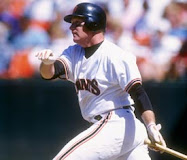
Four-A Player
-Noun
1. Professional baseball player who is too good to play in Triple-A, but is unable to find success at the Major League level:
Todd Linden was a Four-A Player for the San Francisco Giants.
There you go. We've heard it a lot in baseball circles, and thus, that was the best Dictionary.com-esque definition I could come up with for "Four-A Player." A lot of baseball fans of course are on the fence with this term.
Many fans don't think the term exists. They either believe that a.) they aren't Major League players to begin with or b.) they haven't gotten the necessary chances to prove that they are Major League baseball players. They aren't too good for Triple-A or not good enough for the Big Leagues. It's just a matter of the situation a player is in.
Do I believe that? Yes and no. I believe that there are "Four-A Players" out there in the baseball world, and the Giants organization is chock full of them.
Todd Linden was one.
Jason Ellison was one. For whatever reason, they succeeded in Fresno, but couldn't translate that success at the Big League level. Was the competition just meager in Triple-A? Were their skills susceptible to Major League pitching (or hitting in the case of pitchers)? Did they just not have the mental approaches to succeed at the Major League level?
Before I start breaking each player down, I wanted to list some nominees that I thought about writing about, but eliminated.
- Matt Downs and Jesus Guzman. (Still relatively young, as they'll be 26 during the season.)
- John Bowker and Nate Schierholtz. (I think Bowker and Schierholtz are solid, average at the worst Major League players at this moment; their stats from Triple-A haven't transitioned yet, but they aren't busts like Linden.)
- Joe Martinez (His Minor League stats are questionable; so you can make the argument that he may be a borderline Triple-A player, let alone a borderline Major League player.)
Here are the "Four-A Player" candidates: Ryan Rohlinger, Osiris Matos, Kevin Frandsen, and Alex Hinshaw.
Are these guys in the category where they are too good for Triple-A, but not good enough for the Majors? Or are these four players just late bloomers who are capable of achieving success with the Giants as soon as 2010?
Candidate No. 1: Ryan Rohlinger, 3B/2B/SS (27-years-old)
Why Rohlinger May Be Too Good for the Minors.
While everyone and their mother talked about Bowker's breakout in Fresno last season, Rohlinger went largely unnoticed by Giants fans. However, Rohlinger absolutely tore it up in Fresno in 2009. In 126 games, he hit 16 home runs, 37 doubles, scored 74 runs and drove in 78 RBI. Furthermore, he also posted an OBP of .351, an OPS of .813 and had a wOBA (weighted On-Base Average according to Linear Weights) of .360.
In many ways, Rohlinger was an absolute machine at the plate in 2009. Granted, he did manage to strikeout more in Fresno (19 percent) than at any other level in the Minors (his previous high was 18.1 percent in Advanced Single-A San Jose), and his walk rate wasn't very impressive either (7.9 percent) but he still managed to balance it out. His BB/K ratio happened to be 0.47, not incredibly poor considering his relatively high strikeout rates with the Grizzlies.
In terms of his other Minor League numbers, he got off to a slow start, but has showed a lot of success since 2008. After posting batting averages of .252 and .235 in Salem Keizer and Augusta, respectively (in addition to wOBA numbers of .320 and .336), Rohlinger broke out in 2008 in San Jose and Double-A Connecticut. While his power decreased from Augusta (he went from 18 home runs in 2007 to 13 home runs combined in a split season between San Jose and Connecticut), he became a more well-rounded hitter, as evidenced by his increase in batting average (from .235 in 2007 to .289 in combined Advanced Single-A and Double-A numbers), OPS (.747 in 2007 to .811 in 2008) and OBP (.332 in 2007 to .364 in 2008). Also his BB/K ratio numbers remained strong (0.68 and 0.65 in San Jose and Connecticut, respectively) and he actually lowered his strikeout rate to 12.7 percent with the Defenders.
Why Rohlinger Might Not Be Good Enough for the Majors.
While his Minor League numbers are good,
his numbers with the Giants aren't. In 33 games total with the Giants, Rohlinger has a posted a .118 average, an OPS of .347, and a BB/K ratio of 0.14 (compounded by a 3.8 walk rate and 27.5 strikeout rate). In addition, he has only six hits in 53 plate appearances (two doubles and one triple), has scored only two runs and drove in six RBI.
As you can see, Rohlinger just hasn't showed much in limited action at the Major League level. To make matters worse, his projections aren't exactly comforting either. While CHONE projects him to hit 10 home runs and score 50 runs, they also project him to hit low for average (.241) and post low OPS (.685), wOBA (.303) and runs above average based on wOBA (wRAA) numbers (-9.9).
ZiPS seem to feel similar about those projections. They also project Rohlinger to hit 10 home runs, and they actually are more optimistic about Rohlinger in the runs scored and RBI categories (they project him to score 60 runs and drive in 70 RBI). That being said, they also predict paltry averages (.254 batting average, .318 OBP) and they project his OPS+ (
adjusted OPS) numbers to be behind Downs, Guzman, Frandsen and even Steve Holm (a real slap in the face).
Four-A Player or Late Bloomer?
There is a lot to like about Rohlinger. He has good pop on his bat and his defensive numbers weren't terrible in limited action last season (he posted a 12.9 UZR/150 at third base last year, but that was only eight games). However, his BB/K ratios, and low walk rates the past few years have been alarming, especially considering he was very good at drawing walks early in his career (he didn't have a walk rate under 9.9 until his Double-A stint in 2008; it hasn't been over 7.9 at any level since).
Do I think Rohlinger could be a late bloomer? Certainly, but it's not going to be easy. He's got a lot of competition ahead of him, wherever he should play in the infield. He has Pablo Sandoval and Conor Gillaspie (at least in theory) ahead of him at third, Freddy Sanchez, Frandsen, Downs, and Burriss ahead of him at second, and he also has to deal with guys like Juan Uribe and Eugenio Velez who can play multiple positions.
I like his power, and I think he could provide some pop and solid play if given extended time at the Major League level. However, I just can't see that happening with the Giants.
Verdict: Most likely a "Four-A Player". He could be a late bloomer if he goes to a Major League team that will give him opportunity, but who knows if that will happen.
Candidate No. 2: Osiris Matos, RHP (25-years-old)
Why Matos May Be Too Good for the Minors.
Matos has been a solid pitcher in the Minors, especially in Triple-A Fresno. In a five-game stint with the Grizzlies in 2008, Matos struck out 13 batters in 9.2 innings pitched (resulting in a 12.10 strikeout rate) and only walked two hitters (resulting in a 1.86 walk rate and 6.50 K/BB ratio). Additionally, he posted a WHIP of 0.72 and a FIP (Fielding Independent Pitching based on ERA) of 1.14.
In 45 games and 54 innings with the Grizzlies in 2009, Matos continued to post strong numbers. While his strikeout rate went down to 7.95, his walk rate and K/BB ratio remained stellar at 2.15 and 3.69, respectively. Furthermore, his WHIP remained decent at 1.27 (though his FIP could have been better at 3.94).
If there is one thing Matos has shown in his career in the Minors is that he has goo control of his pitches. He has never posted a BB/K ratio under two and he has only had a walk rate higher than three on one occasion (in 2007 in Connecticut where he posted a walk rate of 3.38; accordingly, that was also the season where he had a 2.05 BB/K ratio, the lowest BB/K ratio of his Minor League career).
Why Matos May Not Be Good Enough for the Majors.
He has had two stints in San Francisco (in 2008 and 2009) and neither stretch was really good. In 20.2 IP in 2008, Matos posted a 4.79 ERA, a 4.92 FIP, a 1.69 WHIP and a K/BB ratio of 1.78. For some reason, control suddenly became an issue, as his walk rate ballooned to 3.92 in 2008, the highest number in that category in his professional career.
In 2009, Matos didn't get much of a shot to show whether or not he improved from his rookie stint in San Francisco in 2008. He only got to pitch six innings before he was sent back down to Fresno, and he once again floundered at the Big League level. Matos posted a 2.00 WHIP and a 6.26 FIP (his 9.00 ERA is not a fair indicator because it's based on such a limited number of innings), and allowed seven runs and two home runs in his five outings. Granted, he did improve his strikeout and walk numbers in 2009 (his strikeout rate improved to 7.50, his walk rate dropped to 1.50 and he posted a 5.00 K/BB ratio), but that wasn't enough to counteract that amount of hits he allowed in his short Major League stint. Hitters hit .394 against him and he had a .394 BABIP (batting average of balls put in play) against him in 2009.
There seems to be two main problems with Matos:
1.) Mediocre velocity and effectiveness on his pitches for a reliever.
2.) His flyball rates.
In terms of the former, check out his
Pitch F/X graphs and you can see his fastball velocity in 2009 sorely dipped from 2008. He was close to the 95 MPH range at times in 2008, but he seemed to be regularly around the lower 90's in 2009. His slider also dipped in 2009 by .5 MPH.
When it comes to effectiveness, Matos has struggled to be competent with any of the pitches in his three-pitch arsenal (fastball, slider, changeup). In his two seasons as a Giants reliever, none of his pitches ever had positive value in terms of runs above average.
As for the latter point, it's one thing to be a flyball pitcher (and it's not necessarily a bad thing in AT&T Park). However, Matos' flyball rates are almost too alarming for any baseball fan to be comfortable. He posted a 51.4 percent flyball rate in 2008 and a 56 percent flyball rate in 2009. Furthermore, his groundball rate went down from 24.3 percent in 2008 to 20 percent in 2009, and his GB/FB ratio dipped as well from 0.47 to 0.36.
With those kinds of numbers, Matos is going to be susceptible to giving up a lot of runs, especially home runs, over his career. Last year, his tendency to give up a lot of flyballs bit him in the butt, as he put up a HR/FB rate of 14.3 percent.
Four-A Player or Late Bloomer?
Matos is having a strong Spring Training as he tries to fight for a spot on the 40-Man Roster (he was designated for assignment last season). However, while he is showing that he can be effective in Spring Training, Matos really hasn't shown much at the Major League level in his professional career.
There are some things to like about Matos. He has pretty good control, and...well...I guess that's about it. He throws strikes, but other than that, Matos really doesn't offer the Giants (or any other Major League ballclubs in general) much else. I would never bank on him becoming a decent Big League reliever as a Giants fan (but I wouldn't exactly be surprised if he happened to break out either).
Verdict: Most definitely a "Four-A Player". Unless something dramatic happens this Spring Training, he probably won't be suiting up for the Giants in 2010.
Candidate No. 3: Kevin Frandsen, 2B/SS (27-years-old)
Why Frandsen May Be Too Good for the Minors.
Frandsen has played at three stints in Fresno. You know how's he done? Pretty well. No, pretty well is underscoring it. (That's like saying
Aishwarya Rai is only "pretty hot.") He's done really well at the Triple-A level, and he definitely deserves more credit for his performance in Fresno, especially at the plate.
In 2006, in 71 games and 328 plate appearances with the Grizzlies (his first stint in Triple-A), Frandsen scored 46 runs and hit .304 with a .358 OBP, a .799 OPS and a .357 wOBA. In 2007, in a short 19-game stint before being called up to the Giants, he hit .403, scored 13 runs and posted an OBP of .506, an OPS of 1.029, a wOBA of .462 and a BB/K ratio of 1.50 (he had an 11 percent walk rate and a nine percent strikeout rate in 19 games). And, in 110 games and 474 plate appearances in 2009, (he suffered an Achillies injury in 2008 which way layed him for the entire season), Frandsen hit .295, 13 home runs, scored 67 runs, posted a .352 OBP, a .790 OPS, a .348 wOBA and a 0.68 BB/K ratio.
As you can see, the stats say it all. Frandsen has nothing to prove at the minor league level. In Triple-A, he is not only an excellent player, but he's a bonafide star in the Pacific Coast League if his stats in 2006, 2007 and 2009 say anything.
Why Frandsen May Not Be Good Enough for the Majors.
It's a frustrating fact for Giants fans: as good as Frandsen has been in Triple-A, his stats haven't totally transitioned to the Major League level as many Giants fans would have hoped. He has certainly been on the cusp, and if not for injury and questionable transactions (e.g. the Freddy Sanchez trade), Frandsen's numbers could look a lot different. But the fact of the matter is, Frandsen's numbers are what they are, and unfortunately, they are disappointing, overall.
In 2006, his first stint with the Giants, Frandsen hit .215 in 41 games with a .284 OBP, a .607 OPS and a .268 wOBA. Furthermore, he didn't show much power (only six of his 20 hits were extra base hits) and he didn't show a great approach at the plate either (he had a 0.21 BB/K ratio in 2006).
However, by 2007, Frandsen started to show some signs of life (though nothing totally breakthrough). In 296 plate appearances, he hit .269 and posted a .331 OBP, .710 OPS and a .310 wOBA. While those numbers weren't great by any measure, they certainly were a massive improvement from the previous year. Additionally, Frandsen improved in one category that certainly boded well for future success: BB/K ratio.
Frandsen's BB/K ratio improved from 0.21 in 2006 to 0.88 in 2007. His strikeout rate was under 10 (9.1 percent to be exact), and though his walk rate wasn't incredible (7.1 percent), it certainly was strong enough to complement his low strikeout rate very well. Thus, as evidenced by his strong BB/K ratio numbers, Frandsen showed that he not only had an idea at the plate, but he was very disciplined to boot.
Unfortunately, you don't see BB/K ratio in the box score everyday. You only see batting average, home runs, RBI, etc. So, because Frandsen's numbers in those categories weren't impressive, he was automatically dismissed. He didn't have power, he didn't have speed (unlike Velez or Emmanuel Burriss), so Frandsen didn't stick out to Giants fans. To make matters worse, Frandsen got hurt in 2008 and missed the entire 2008 season, which only put his progress and baseball career back.
Once Frandsen returned to baseball in 2009, he struck a bad string of luck. He couldn't buy a hit in 2009. His batting average was .140, his OBP was .204, his OPS was .384 and his wOBA happened to be .182. All those numbers are atrocious, even if he only played in 20 games and had only 53 plate appearances in 2009. If you want to prove you are a player worthy of starting, you have to put up better numbers than what Frandsen put up in 2009.
Or does he?
Why do I suggest that? Because Frandsen put up two numbers that show that his 2009 season may not have been as bad as everyone may have thought: a .152 BABIP and a 0.75 BB/K ratio.
To put things in perspective, his BABIP was the lowest of any player (pitchers included) with 30 or more plate appearances. Thus, Frandsen was pretty darn unlucky in 2009, and to think he'll be that unlucky again in 2010 would be foolish. In addition, his BB/K ratio almost proves that he won't be that unlucky again either (because it's evidence that his plate discipline is solid, something you can't necessarily say of a lot of Giants hitters). His 0.75 BB/K ratio was second-highest on the team of anyone with 30 or more plate appearances (behind only Ryan Garko, who had a 0.90 BB/K ratio; he's gone by the way).
Four-A Player or Late Bloomer?
Many people are on the fence with this argument. Many believe that he is not that good of a ballplayer, while some believe he is on the cusp of breaking out,
but just isn't getting a shot. Where am I? I believe in the latter. Frandsen's Triple-A stats and BB/K ratios convince me, and I'm in the camp that believes he should be starting on Opening Day at second base (or even shortstop) over Juan Uribe (who had an abnormally good offensive year, and is
not as good a defensive player at shortstop as Giants would like to think).
No one should ever call Frandsen a "Four-A Player" ever. The guy is under appreciated, and once he gets his shot (either in San Francisco or elsewhere), he'll prove his doubters wrong.
Verdict: Frandsen just needs his chance. Whether he gets that with the Giants is to be determined, but he's definitely capable of being a serviceable, if not good, Major League player.
Candidate No. 4: Alex Hinshaw, LHP (27-years-old).
Why Hinshaw is Too Good for the Minors.
Hinshaw is a strikeout machine. Take a look at his numbers in the minors and you'll see what I'm talking about:
2006 in San Jose: 10.08 strikeout rate, 78 strikeouts in 69.2 innings pitched.
2007 in Connecticut: 10.57 strikeout rate, 45 strikeouts in 38.1 innings pitched.
2008 in Fresno: 12.06 strikeout rate, 21 strikeouts in 15.2 innings pitched.
2008 in San Francisco: 10.66 strikeout rate, 47 strikeouts in 39.2 innings pitched.
2009 in Fresno: 12.38 strikeout rate, 72 strikeouts in 52.1 innings pitched.
Holy schnikies those strikeout numbers are good! Granted, Hinshaw has had problems with control, for he's only had a K/BB ratio over three once, and that was in 2008 in Fresno. Also, his FIP numbers haven't been great either, as evidenced by him having a FIP under three only twice (2.94 in 2007 in Connecticut and 1.29 in 2008 in Fresno), but you can't deny the strikeout numbers. Hinshaw can make batters miss and for a reliever, that's what you want.
Why Hinshaw Might Not Be Good Enough for the Majors.
Like I said, his control is a major issue. Despite his strong strikeout numbers in 2008 with the Giants, his K/BB ratio was only 1.62 and his FIP was only 4.82 (not especially good for a reliever). To make matters worse, he had an absolutely awful showing in 2009 in San Francisco.
In nine appearances and six innings, Hinshaw posted only a strikeout rate of three, a walk rate of 10.50, a K/BB ratio of 0.29, a HR/9 (home runs allowed per nine innings) of three, and a FIP of 10.26. Even for a brief stint those numbers are atrocious.
What could be Hinshaw's problem? Well, other than his inability to be consistent in terms of finding the strike zone, there are serious issues with his velocity, as you can see in his
Pitch F/X graphs.
In 2008 with the Giants, his velocity on his fastball ranged from the low to mid-90's and his aveage velocity on his fastball clocked at 92.4 MPH. In 2009 in San Francisco, he was consistenly in the low 90's range and his average fastball velocity dipped to 91.1 MPH. How big a deal is that? It's hard to tell, especially considering his 2009 was such a limited sample. That being said, considering striking guys out is such a key to Hinshaw's game as a pitcher, the drop in velocity on his fastball is concerning, if not discouraging.
Four-A Player or Late Bloomer?
I am one of the few believers in Hinshaw. While his 2008 wasn't great, it was promising. And, while I believe his 2009 in San Francisco was horrendous, his 2009 numbers in Fresno illustrate that he is still able to strike guys out. Will he ever be able to find control at the Major League level? Will he ever be able to recover from his porous 2009? Was his drop in velocity an aberration or a sign of things to come?
There are a lot of questions about Hinshaw as the Giants approach Opening Day. Unfortunately, with Guillermo Mota, Denny Bautista and Santiago Casilla, all proven Major League relievers (or at least in Mota and Casilla's case) vying for roster spots, Hinshaw looks to be the odd-man out. If anything, he probably won't get a chance to prove that his control problems are a thing of the past in a Giants uniform.
Verdict: I like him a lot, but his control, age, and dip in velocity will probably keep him from being a decent Major League reliever. Most likely a "Four-A Player."


 Posts
Posts